Screw Piles in Airdrie, AB
Airdrie screw pile foundations for garages, additions and decks, built for heavy local clay. We help with City of Airdrie permits and add no travel fee.
Throughout Airdrie, Chinook Screw Piles sets helical screw piles under new decks, garage grade beams and home additions, and underpins older footings once they begin to shift. Every pile is checked against its torque target, permits get stamped drawings when they require them, travel costs you nothing, and quotes land within 48 hours.
At a Glance
- Municipality
- City of Airdrie
- Residents
- 80,649
- Postal Prefixes
- T4A, T4B
- Quote Timing
- Your quote within 48 hours
Screw Pile Foundations for Airdrie Soil
What the soil is like
Heavy glaciolacustrine clay of high plasticity, typical of the plain north and east of Calgary. It swells when wet and shrinks when dry, and that cycle heaves and cracks shallow footings.
Permits and approvals
Building permits in this area come from City of Airdrie. For addresses within city limits, the City of Airdrie issues the permits. Sort out which side of the boundary you are on before anything else: the city has expanded so quickly that many properties described as "Airdrie" actually fall under Rocky View County, which is its own authority with its own rules. Airdrie also has an extra approval step that is uncommon in Calgary. A lot of the newer subdivisions are subject to architectural guidelines and restrictive covenants set by the developer, so a garage or deck the City approves may still need a separate sign-off from the developer. When a project needs engineering, the drawings are stamped by an Alberta P.Eng. working through an APEGA permit holder, and a torque record is provided for each pile. Ask the City for current fees and review times.
Typical projects
Garage and deck foundations across the newer subdivisions, and shops on acreages just past the city boundary.
Below the surface in Airdrie
North of Calgary, along Nose Creek, Airdrie is built on a broad and nearly level clay plain. What causes trouble in that soil is not weakness so much as plasticity: the clay gains volume when it gets wet and loses it again as it dries. Those swings happen mostly within the top metre or two, and that is exactly where a deck ledger pulls away from a house or a garage door frame goes out of square. Think of it as a water-content issue first and a bearing issue second.
You might expect level ground to be kinder. It is the reverse. With almost no natural slope carrying runoff off the lot, how wet the clay gets is decided mostly by people — where the downspouts discharge, how the yard was graded, how much the lawn is watered, where the snow piles up. Every one of those tends to change once a homeowner moves in, and seldom in the foundation’s favour.
Then there is the pace of development. Entire subdivisions in Airdrie are cut and filled in one pass long before construction starts, so the back yard of a brand-new home may rest on imported fill whose depth no one on site can tell you — and it often changes from one side of the lot to the other. That is the reason a screw pile foundation here is accepted on the installation torque we actually measure, not on a depth borrowed from the neighbour’s install.
The projects we see locally
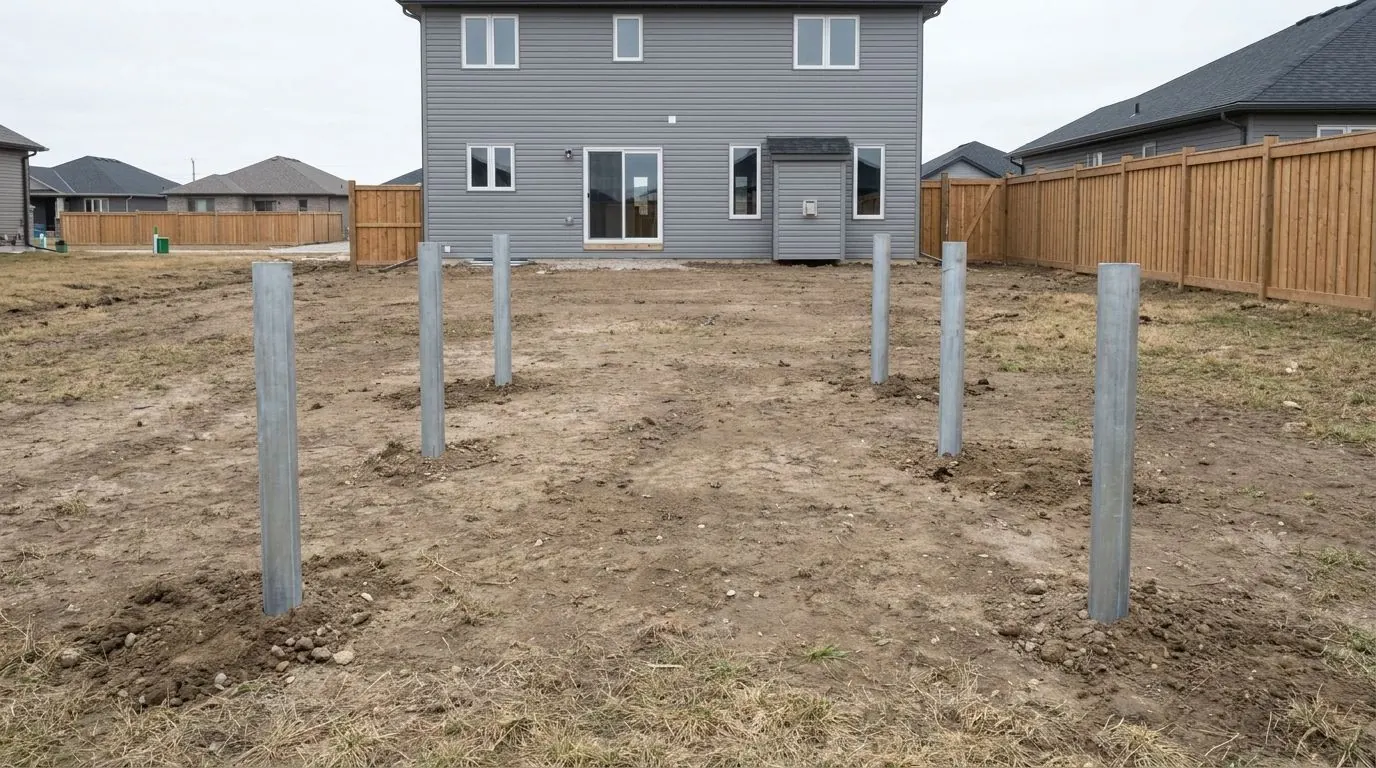
Airdrie’s homes are mostly young, so we are seldom rescuing an old failing foundation. What we see instead is owners adding to a newer house: rear decks and covered decks, pads for hot tubs, detached or oversized garages, sunrooms, and now and then a retrofitted side entrance. The lots tend to be open and flat with room for equipment — nothing like squeezing into a Calgary infill yard — so getting a machine in is rarely what slows the job down.
Cross the city limit and the work turns rural. Acreage owners want post-frame shops, sheds for equipment and animal shelters, all sitting on that same clay and with no municipal services. These are tall, lightweight buildings that catch the wind, which means resisting uplift is every bit as important as carrying weight. Helical screw piles are installed with a recorded value for both.
No screw pile here goes in to a preset depth. It keeps turning until the torque reading shows it has reached the capacity the engineer asked for, which in soil this variable can leave two piles a few metres apart ending at different depths — with neither one wrong. Read more on screw pile depth in Alberta .
Our Airdrie coverage
The map outlines where we install, not a location to drop in on. With Chinook Screw Piles, the rig, the crew and the screw piles all travel to your property. Airdrie sits inside our normal working radius, so quotes here carry no travel fee.
City of Airdrie handles permits for projects within the area on this map.
What We Do in Airdrie
Jobs range from a few deck piles up to commercial foundations, with grade beams and underpinning in between. Open any service to read how it applies in Airdrie.
Deck Foundations
Nothing to dig, nothing to cure — start framing that day.
Garage Foundations & Grade Beams
Screw piles and grade beams engineered around Calgary clay.
Home Additions & Sunrooms
Set close to the house while the old foundation stays untouched.
RTM, Modular & Mobile Home Foundations
Engineered screw pile foundations under RTM and modular homes.
Foundation Underpinning
Halt the settlement and carry the house on engineered screw piles.
Foundation Lifting & Levelling
Raise a sunken structure toward the elevation it started at.
Basement Wall Anchors & Tiebacks
Hold a bowing basement wall where it is — and often draw it back.
Slab Jacking & Concrete Lifting
Bring sunken concrete back to level and keep the slab you have.
Commercial Piling
Solar arrays, EV charger bases, sign footings and grade beams.
Industrial & Oilfield Piling
Pipe racks, wellheads, compressor stations and remote sites.
Engineering & Pile Load Testing
Stamped drawings, load tests and torque checked against capacity.
Also Close to Airdrie
Our crews regularly work in these neighbouring communities as well.
Ground and projects around Airdrie

Airdrie Screw Pile FAQ
How deep does a screw pile foundation go in Alberta?
Is a screw pile foundation less expensive than concrete?
What are the drawbacks of screw piles?
Do screw piles go in during the winter?
Is there an extra charge to travel to Airdrie?
Planning a screw pile foundation in Airdrie?
Give us a call or send your project details, and we will get back to you with a price. Chinook Screw Piles is based in Calgary (WCB Alberta covered, Fully liability insured) and works across Airdrie and the communities around it.