How Deep Do Screw Piles Go in Alberta?
Ask ten homeowners what they want to know first about a screw pile foundation and most will say “how deep?” The straight answer isn’t a measurement. A helical screw pile has gone far enough once it sits in ground able to hold the load, and what tells us that is the torque reading rather than the length of steel below grade.
Because that runs against intuition, here is the reasoning behind it.
Frost is the floor, not the target
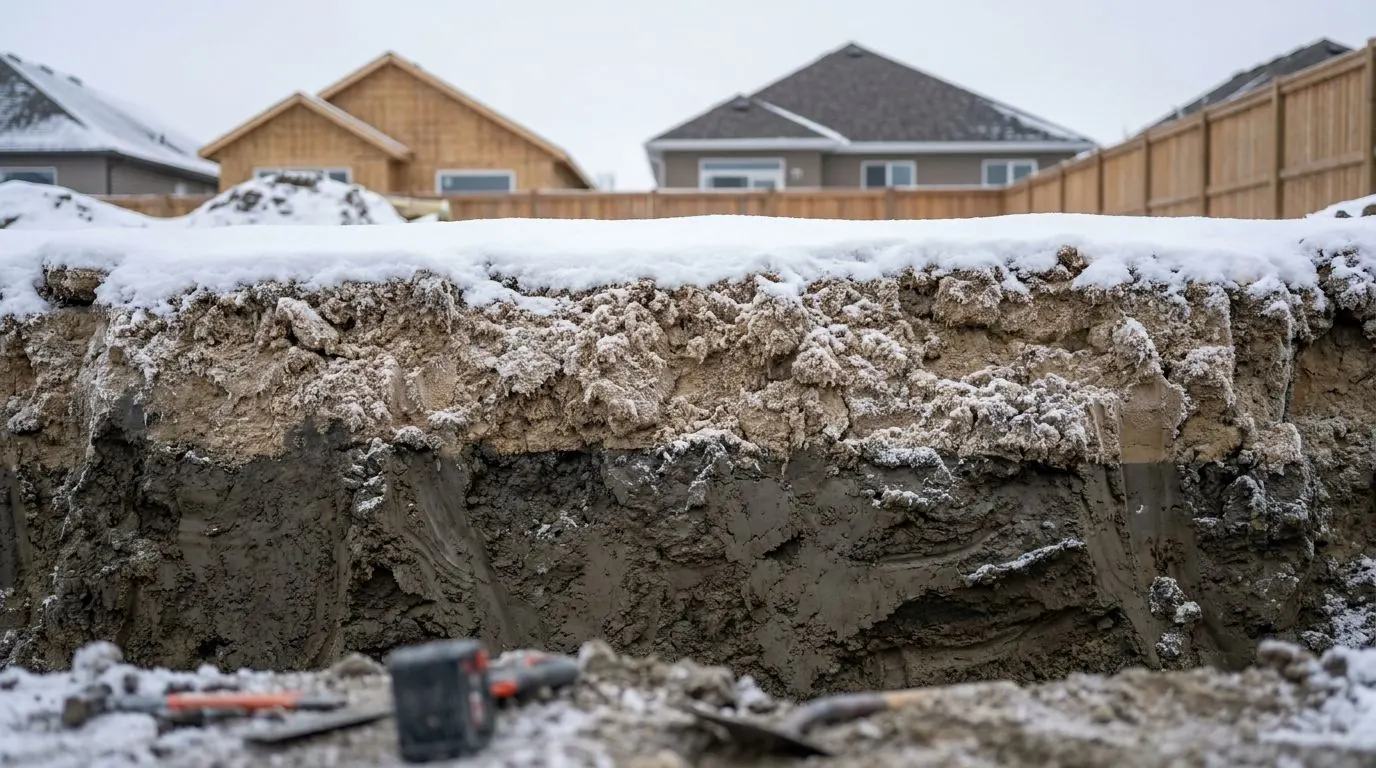
Around Calgary, frost depth is commonly cited at roughly 1.2 to 1.8 metres, though your site and your engineer set the real figure. Anything bearing inside that band rests on soil that swells as it freezes and slumps back as it thaws. Repeat that every year and you get heaved deck posts, cracked garage slabs and door frames pulled out of square.
Clearing the frost zone, then, is only the starting requirement. Nobody should treat it as the finish line.
Competent strata is the target
What sits under the frost layer changes a lot across the region. Much of the north and east of the city is glaciolacustrine clay that shrinks and swells readily. Older inner-city lots often hide layers of mixed fill placed over many decades. Out west toward Cochrane, crews run into dense glacial till, cobbles and bedrock close to the surface, while the south brings silt and river-valley alluvium.
It is entirely ordinary for two homes only a few kilometres apart to need different pile depths for an identical deck. A single depth written into a spec can’t account for that; measuring on site can.
Torque is how capacity is verified
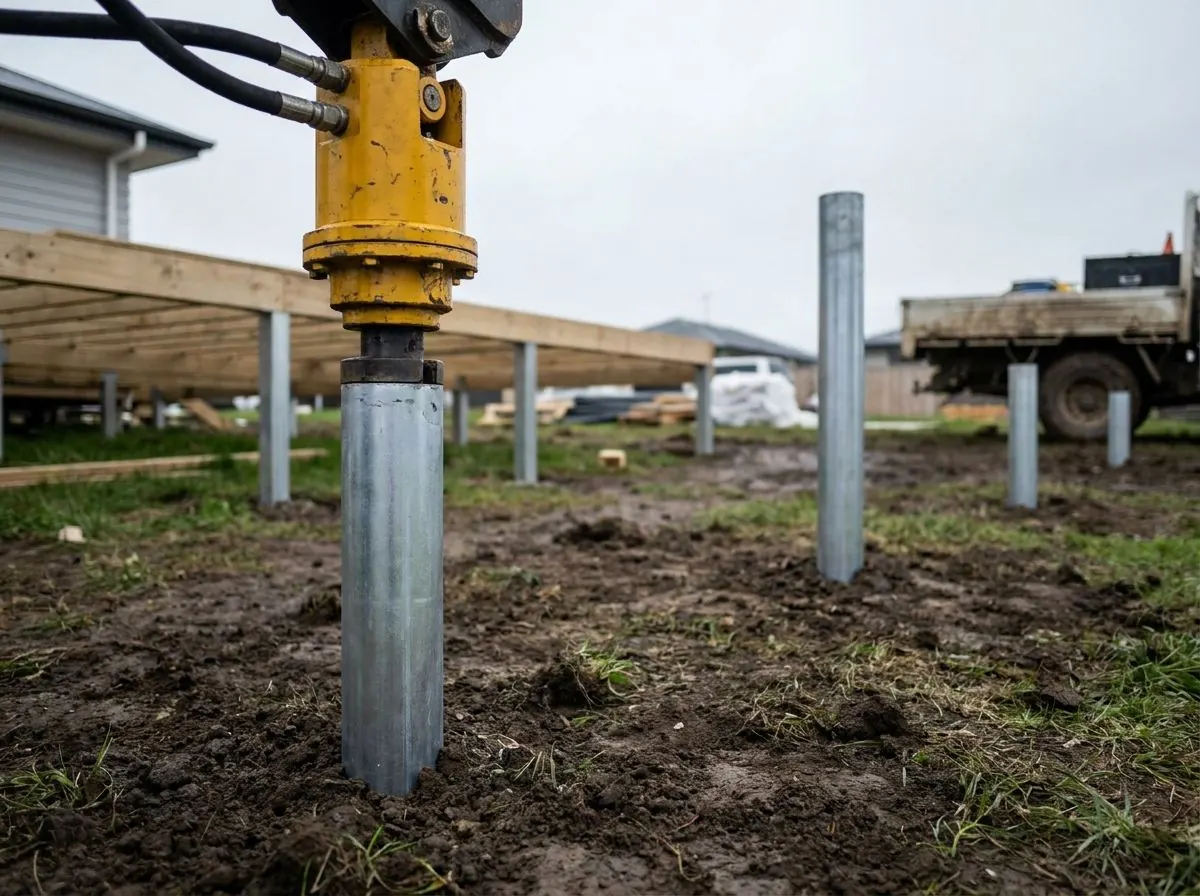
While a helical pile is being screwed down, the rotational resistance it encounters is recorded as installation torque. That reading correlates with bearing capacity. When the pile hits the torque value set out in the engineering, it has arrived in soil able to support the load it was designed for.
At that point, and not before, the depth is sufficient.
On a real site, that often means piles a few metres apart stop at different depths and every one of them is right. One met firm soil early; its neighbour kept going until it did. Each supports its design load, and each has its own torque entry to show for it.
What you should receive
Whenever piles are engineered, the paperwork you should expect includes:
- The torque log — installation torque as recorded, pile by pile
- Verified capacity — the bearing and uplift that each torque figure represents
- Stamped drawings in cases where the permit calls for them
- An as-built that marks where every pile ended up and how deep it went
Without a torque record, a pile is little more than a post screwed into the dirt. Those documents are what separate an actual foundation from a hopeful guess.
The short version
Getting under frost is the baseline, bearing soil is the goal, and the torque log is your evidence. If a quote lists one depth for every pile on your lot with no plan to measure, ask how capacity will be confirmed, and pay attention to the answer.
Thinking about screw piles for your project?
Questions after reading this, or ready for a price? Get in touch — we install screw pile foundations in Calgary and the towns around it.