Industrial & Oilfield Piling in Calgary
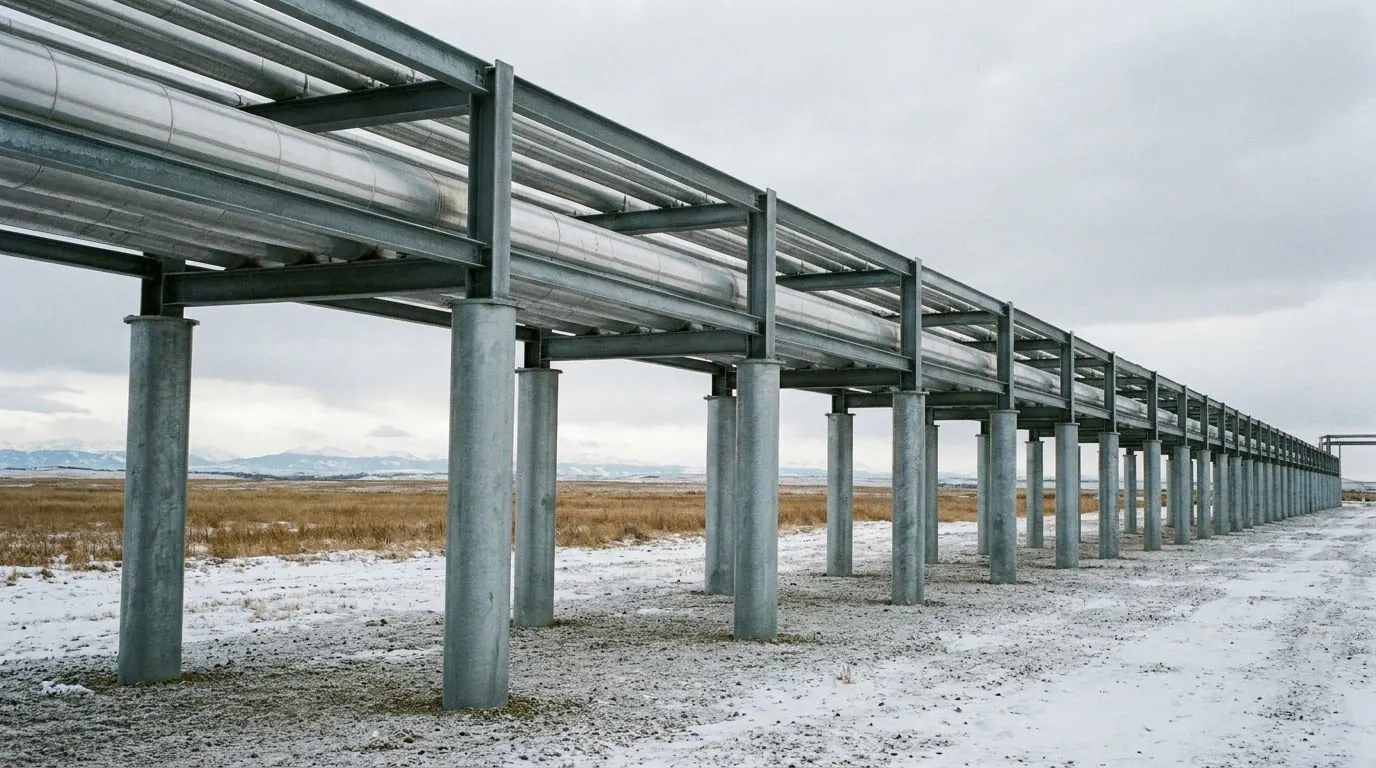
Oilfield and industrial helical piles under pipe racks, compressor stations, tanks, substations, header and wellhead supports, and remote sites.
How Industrial & Oilfield Piling Works, Step by Step
Here is the sequence we run on these jobs, laid out ahead of time so nothing between the first site visit and the last torque reading comes as a surprise.
Quote
Email us drawings or rough measurements — a quote is usually back with you within 48 hours.
Site visit
Before anything is booked, we check the lot for access, likely soil conditions and the pile layout.
Engineering
If your permit calls for them, we supply load calculations and drawings under a professional stamp.
Install
Each screw pile is turned down until it reaches its engineered torque. A typical house job is finished in roughly half a working day.
Torque log
At handover you get the installation torque for every pile, its verified capacity and the as-built records.
The real work behind industrial & oilfield piling
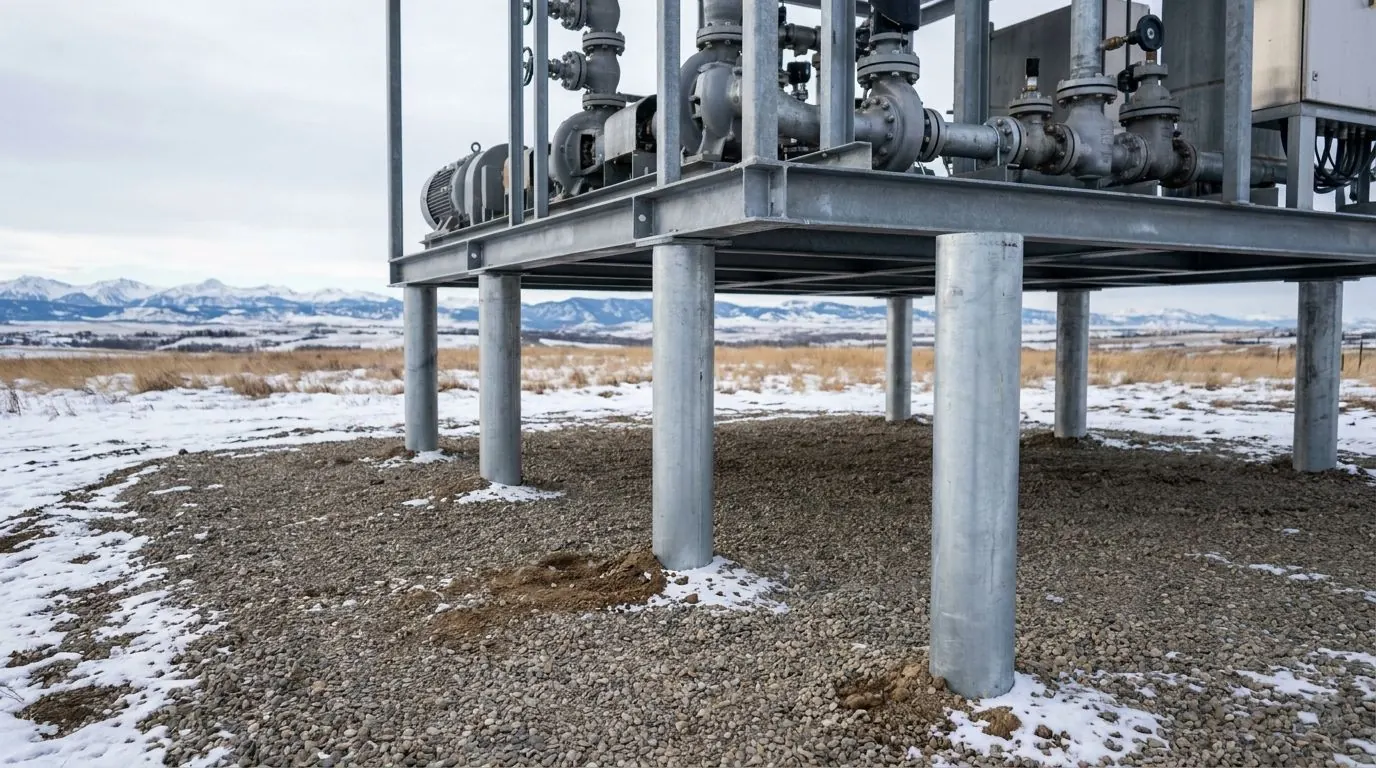
On industrial and oilfield sites, the screw piles themselves are seldom the difficult part. Bases for pump jacks, skids carrying compressors and other equipment, sleepers and pipe racks, supports under wellheads and headers, metering stands, platforms for tanks and shelters — the engineering is well established and the loads are light by industrial measures. What actually determines whether a contractor can take the work is getting onto the lease in the first place: the prequalification, the safety documents, the orientation, proof of worker competency and a settled prime contractor, every item cleared ahead of the first pile.
So here is our position up front, because procurement teams are tired of learning it at audit time. We carry active WCB Alberta coverage, and a clearance letter is yours on request. We hold commercial general liability insurance. Our Certificate of Recognition (COR) is IN PROGRESS — it has not been issued to us. Any gate asking for a live COR number, or for membership in a prequalification portal we have not joined, is one we fail today; better you hear it before issuing the tender than after.
Beyond compliance, it comes down to logistics. Leases are remote, access roads are seasonal, the ground is often soft or sensitive for reclamation, and the access window is usually the tightest constraint. A helical screw pile crew is small and self-sufficient — one operator, one carrier with its drive head, and a load of steel — no ready-mix truck needing a route in and nothing waiting to cure.
On site, from start to finish
Most of the job is done before mobilisation. The prime contractor is confirmed in writing. Hazard assessments and JSAs are written for this particular site and this particular scope instead of recycled. Orientation is completed under the operator’s own system, whatever that happens to be. Before any steel arrives, the ground disturbance permit, locates (operator-owned lines included), any crossing agreements and the work permit are finished. Where the site classification demands tickets or monitoring our crew lacks, you hear that from us, and we either bring them in or walk away from that part of the scope.
In the field, the schedule bends around access more than weather. Mats go down wherever the ground is soft or where leaving ruts would itself be a liability, and a January lease is often easier to reach than a July one, because frozen muskeg holds up equipment that thawed muskeg swallows. Each pile gets a torque reading tied to a capacity correlation, and you receive that log itself, not a summary of it. Because nothing cures, the millwright crew can land a skid on the piles within hours, which is why screw piles fit turnaround windows. When the facility is decommissioned, the piles can be pulled and the steel recovered.
What shapes the design
Uplift, load reversal and lateral forces tend to govern more than dead weight. A pump jack puts a repeating, reversing load into its base. Pipe racks have to be split into anchor bays and guide bays: as the line grows and shrinks with temperature, the axial thrust lands on some supports and bypasses others. On a slender, lightweight stand, wind alone can exceed the weight of everything mounted on it. Design a rack as if every bay were the same and it will move at the anchor bay.
Corrosion and clearances cover the rest. If the geotechnical or environmental reporting mentions salinity, low soil resistivity or a history of produced-water releases, then the coating and the extra sacrificial steel thickness need to be written explicitly into the specification, alongside a stated design life. Pile spacing is often dictated by the buried pipeline corridor rather than soil behaviour, since the required clearance from live lines can eliminate the spot the drawing called for.
Industrial & Oilfield Piling Near You
Soil, slope and the office that issues your permit all change from one community to the next. Choose yours below to see how industrial & oilfield piling plays out locally in Calgary and the towns around it.
City of Calgary
Your quote within 48 hours
City of Airdrie
Your quote within 48 hours
Rocky View County
Your quote within 48 hours
Foothills County
Your quote within 48 hours
City of Chestermere
Your quote within 48 hours
Wheatland County
Your quote within 48 hours
Foothills County
Your quote within 48 hours
Rocky View County
Your quote within 48 hours
Industrial & Oilfield Piling: photos from the field
Common Questions on Industrial & Oilfield Piling
How deep does a screw pile foundation go in Alberta?
Is a screw pile foundation less expensive than concrete?
What are the drawbacks of screw piles?
Do screw piles go in during the winter?
Planning Industrial & Oilfield Piling?
Tell us about the project and we will price it at no charge. Chinook Screw Piles puts engineered helical screw piles in the ground throughout Calgary and its neighbouring towns — phone or send the details, whichever is easier.