Engineering & Pile Load Testing in Calgary
APEGA-stamped drawings and as-built certification, pile load testing, custom fabrication, and installation torque checked against CCMC-evaluated capacity tables.
How Engineering & Pile Load Testing Works, Step by Step
Here is the sequence we run on these jobs, laid out ahead of time so nothing between the first site visit and the last torque reading comes as a surprise.
Quote
Email us drawings or rough measurements — a quote is usually back with you within 48 hours.
Site visit
Before anything is booked, we check the lot for access, likely soil conditions and the pile layout.
Engineering
If your permit calls for them, we supply load calculations and drawings under a professional stamp.
Install
Each screw pile is turned down until it reaches its engineered torque. A typical house job is finished in roughly half a working day.
Torque log
At handover you get the installation torque for every pile, its verified capacity and the as-built records.
The real work behind engineering & pile load testing
We offer this as a standalone service because proving a screw pile is a separate task from installing one. Installation torque is the recognised field method for verifying helical piles, but a torque reading is just newton-metres until someone converts it to capacity using a correlation they are prepared to stand behind. Everything in this service is about making that conversion reviewable by people who were not standing beside the rig — the engineer of record, a municipal building official, a third-party inspector.
Normally that correlation comes from a CCMC evaluation. For a named pile product, the Canadian Construction Materials Centre checks compliance with the National Building Code and lists certified allowable capacities against the torque reached at final installation. Those tables apply only to that product — the steel going into the ground must be the steel named in the report — and evaluations do expire. Anyone can search the public registry in about a minute, so we point you there rather than printing report numbers on this site — more than once, a number handed over by a supplier did not survive that search.
When a design falls outside the published tables — loads beyond the listed range, a helix configuration the report does not cover, or soil the correlation was never calibrated to — nobody should stretch the table to fit. The right move is to load-test piles on that site and have the results interpreted by a P.Eng. licensed with APEGA.
On site, from start to finish
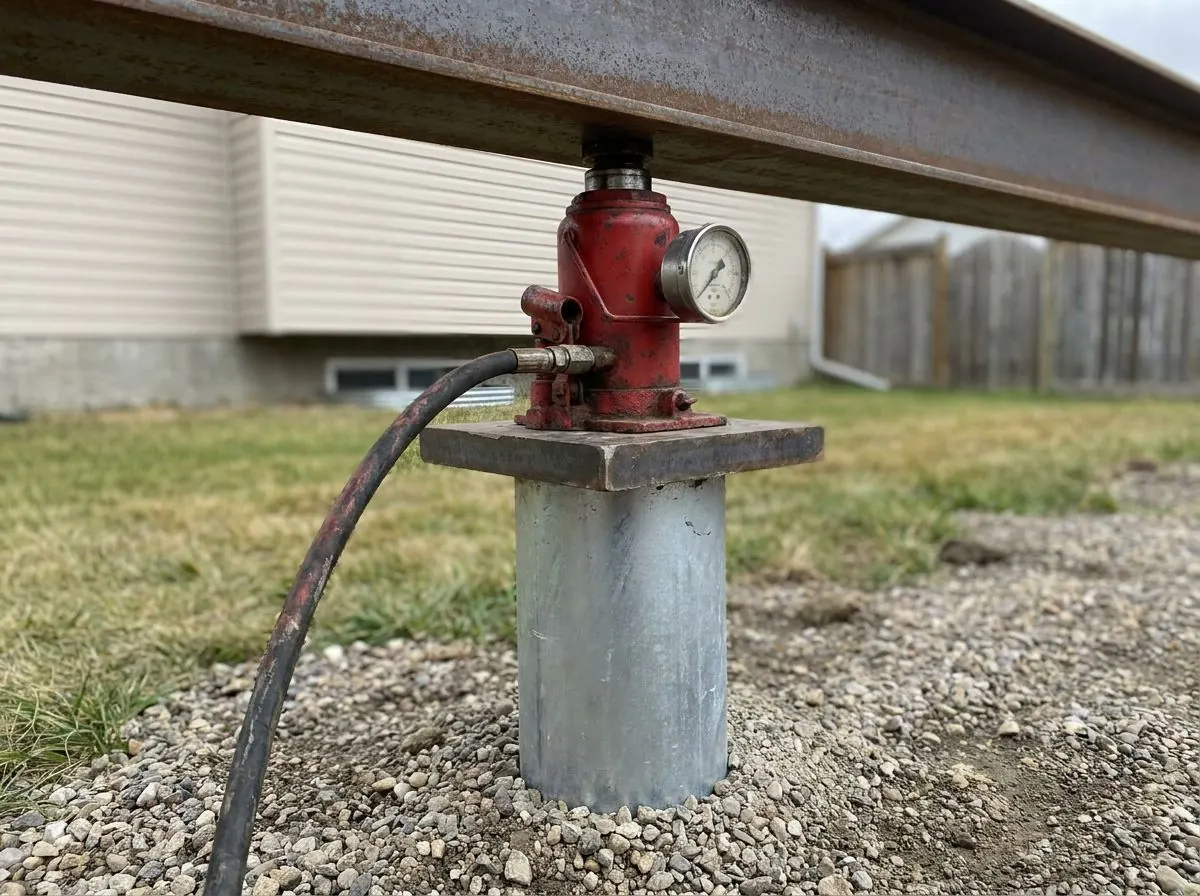
Think of a load test as a carefully controlled experiment on one pile. A hydraulic jack pushes or pulls on the test pile while reacting against a frame supported on reaction piles or anchors placed far enough away that their zones of influence do not overlap; set them too close and they stiffen the soil around the test pile and make the result look better than it is. Load is read from a calibrated load cell rather than estimated from jack pressure, and movement is measured with dial gauges or LVDTs mounted on a reference beam supported outside both zones. Load is applied in steps and removed in steps, with rebound recorded. You get back a plot of load against displacement plus an interpreted capacity that names the criterion used, since different criteria pull different numbers from the same curve.
The paperwork spans far more than test day. It opens with a desk review comparing the geotechnical report to the pile schedule, so a conflict between the two surfaces while it is still only ink, and carries on through APEGA-stamped drawings, torque records for each pile and as-built locations. It finishes with a field review letter when the authority having jurisdiction calls for one. When we test screw piles that another contractor installed, we note that on the record and report exactly what we measured, including results that fall short.
What shapes the design
Settle the shape of the test programme before anyone mobilises; it comes down to five choices. Quantity — testing a percentage of the production piles, or putting in sacrificial piles first, while there is still time to revise the design. Direction — push, pull or sideways, picked to reflect the load case that actually governs rather than whatever was done last time. Magnitude — how many times the design load the pile will see. Pass/fail — the acceptance criterion, stated in writing. Reaction — what the frame and its anchors can resist, because that ceiling is frequently reached before the pile gives up.
The torque-to-capacity ratio depends on shaft geometry — smaller-diameter shafts have a higher ratio than larger ones — and is not a universal figure pulled from memory. Its value is taken from either the evaluation report or a load test, and the paperwork should say which. Torque measured by a calibrated drive head with an up-to-date calibration record counts as evidence; torque estimated from an uncalibrated hydraulic circuit is only a guess.
Engineering & Pile Load Testing Near You
Soil, slope and the office that issues your permit all change from one community to the next. Choose yours below to see how engineering & pile load testing plays out locally in Calgary and the towns around it.
City of Calgary
Your quote within 48 hours
City of Airdrie
Your quote within 48 hours
Rocky View County
Your quote within 48 hours
Foothills County
Your quote within 48 hours
City of Chestermere
Your quote within 48 hours
Wheatland County
Your quote within 48 hours
Foothills County
Your quote within 48 hours
Rocky View County
Your quote within 48 hours
Engineering & Pile Load Testing: photos from the field
Common Questions on Engineering & Pile Load Testing
How deep does a screw pile foundation go in Alberta?
Is a screw pile foundation less expensive than concrete?
What are the drawbacks of screw piles?
Do screw piles go in during the winter?
Planning Engineering & Pile Load Testing?
Tell us about the project and we will price it at no charge. Chinook Screw Piles puts engineered helical screw piles in the ground throughout Calgary and its neighbouring towns — phone or send the details, whichever is easier.