Slab Jacking & Concrete Lifting in Calgary
Driveways, garage pads, patios and walkways that have sunk are raised level again, and you keep the slab you already have.
How Slab Jacking & Concrete Lifting Works, Step by Step
Here is the sequence we run on these jobs, laid out ahead of time so nothing between the first site visit and the last torque reading comes as a surprise.
Quote
Email us drawings or rough measurements — a quote is usually back with you within 48 hours.
Site visit
Before anything is booked, we check the lot for access, likely soil conditions and the pile layout.
Engineering
If your permit calls for them, we supply load calculations and drawings under a professional stamp.
Install
Each screw pile is turned down until it reaches its engineered torque. A typical house job is finished in roughly half a working day.
Torque log
At handover you get the installation torque for every pile, its verified capacity and the as-built records.
The real work behind slab jacking & concrete lifting
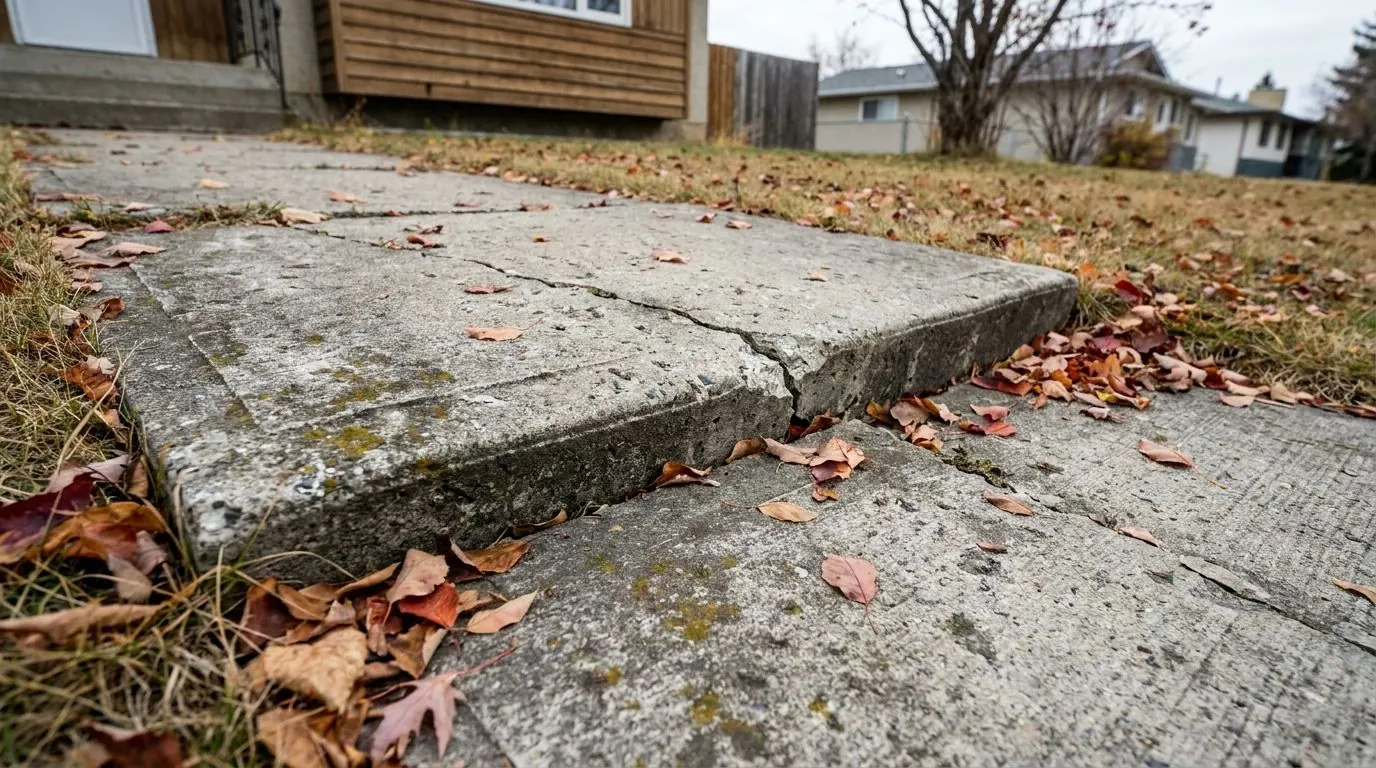
It helps to be clear about what flatwork actually is, because everything else follows from it. A driveway, garage floor, sidewalk or patio has no footings and no screw piles beneath it. It is simply a sheet of concrete lying on soil, and that soil is all the support it has. When the ground underneath shrinks away, the slab has nothing to bridge to, so it sinks with the soil or snaps and tilts on one edge.
Soil loses volume for everyday reasons. Backfill along a foundation keeps compacting for years, which is why the walkway beside the house is almost always the piece that sinks. Water pouring from a downspout carries fine particles out from below, and a loosely filled utility trench settles along its full length. Clay contracts during a dry summer. Frost heaves a slab in winter and does not always set it back where it was.
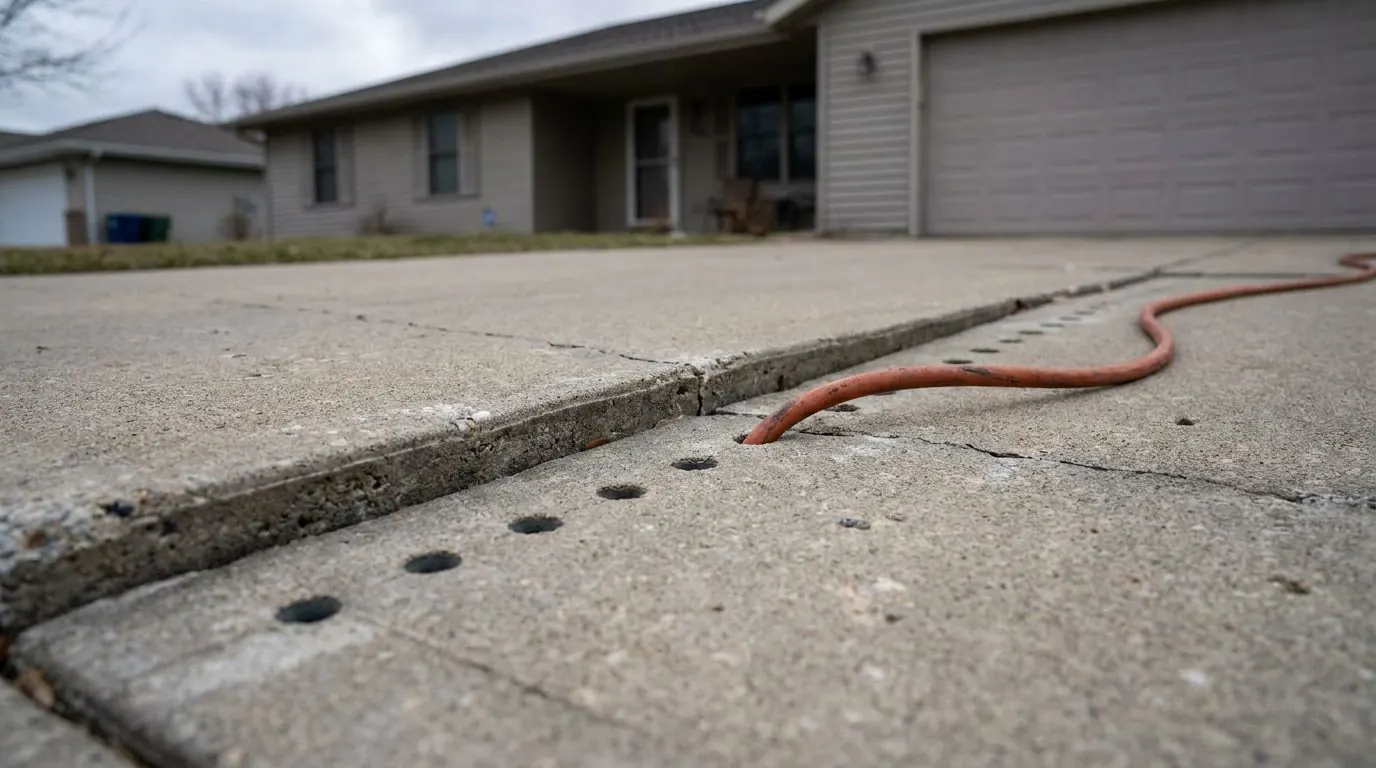
Slab jacking deals with the empty space. Small holes are drilled through the concrete and material is pumped underneath under pressure until the slab rises back to where it belongs. To be plain about it: this is not screw pile work. Nothing is installed into firm soil, no load is carried to depth, and no torque record comes out at the end. That also defines what it cannot do: filling a void addresses the gap, not whatever created it. If the slab is shifting because a footing under it is settling, because clay beneath it is heaving, or because water is still getting in, the injection raises the concrete and it simply moves again.
On site, from start to finish
It is a different set of tools and a very different day on site. There is no drive head, no digging and no bracket. Holes are laid out around the slab’s control joints and the area where the void is thought to be; injection ports are set and material is pumped in. The rise is monitored at the surface in real time, especially at joints with neighbouring slabs, steps and aprons, because those adjoining surfaces set the target height. Material goes in gradually on purpose — forcing a lot through a single port is the textbook way to break the very slab you came to fix.
The holes get patched once lifting is done. Since nothing is formed and no new concrete is placed, the wait before you can drive or walk on it depends on the injected material setting, not on concrete curing. One point worth making at the start: existing cracks do not go away. Raising a cracked slab raises its pieces, and the crack may look slightly more obvious afterwards. What you are paying for is height, not a fresh surface.
What shapes the design
Whether a slab can be raised at all depends on the concrete, not on the void beneath it. Its thickness, whether it has reinforcing, and how it is already cracked decide if it comes up as one plane or as separate chunks. A plain slab that is already broken into sections will rise as those sections, leaving you with level pieces and the joints between them. That call gets made before any price is given.
After that it comes down to how large the void is, which dictates how much material is needed, and what the slab has to line up with along its edges. A garage floor meets an apron and the overhead door track; a sidewalk meets steps and a doorway. Those fixed features define the target height more firmly than the original grade ever did. Anything below the slab — buried utilities, a drain line, a vapour barrier — has to be identified before the first hole is drilled.
Slab Jacking & Concrete Lifting Near You
Soil, slope and the office that issues your permit all change from one community to the next. Choose yours below to see how slab jacking & concrete lifting plays out locally in Calgary and the towns around it.
City of Calgary
Your quote within 48 hours
City of Airdrie
Your quote within 48 hours
Rocky View County
Your quote within 48 hours
Foothills County
Your quote within 48 hours
City of Chestermere
Your quote within 48 hours
Wheatland County
Your quote within 48 hours
Foothills County
Your quote within 48 hours
Rocky View County
Your quote within 48 hours
Slab Jacking & Concrete Lifting: photos from the field
Common Questions on Slab Jacking & Concrete Lifting
How deep does a screw pile foundation go in Alberta?
Is a screw pile foundation less expensive than concrete?
What are the drawbacks of screw piles?
Do screw piles go in during the winter?
Planning Slab Jacking & Concrete Lifting?
Tell us about the project and we will price it at no charge. Chinook Screw Piles puts engineered helical screw piles in the ground throughout Calgary and its neighbouring towns — phone or send the details, whichever is easier.