Screw Piles in High River, AB
High River screw pile foundations that pass through river alluvium and post-flood ground to reach competent strata beneath.
Throughout High River and Foothills County, Chinook Screw Piles sets helical screw piles under new decks, garage grade beams and home additions, and underpins older footings once they begin to shift. Every pile is checked against its torque target, permits get stamped drawings when they require them, travel costs you nothing, and quotes land within 48 hours.
At a Glance
- Municipality
- Foothills County
- Residents
- 14,324
- Postal Prefixes
- T1V
- Quote Timing
- Your quote within 48 hours
Screw Pile Foundations for High River Soil
What the soil is like
Highwood and Little Bow river alluvium containing silt lenses. After the flood, fill varies from lot to lot, so each pile is verified by torque rather than an assumed depth.
Permits and approvals
Building permits in this area come from Town of High River (Foothills County outside town limits). Inside the town, the Town of High River is the authority having jurisdiction; beyond its limits, Foothills County takes over. Flood hazard mapping and its associated rules have a real effect on what may be built and at what elevation — yet those rules have changed more than once since 2013, and they are exactly the sort of thing you should never take from a contractor’s web page. Before you design around an assumption, ask the town’s planning office where things stand for your parcel today. When engineered drawings are needed, we provide an APEGA-stamped design and a torque log for each pile.
Typical projects
Foundations for rebuilds and additions, shops on acreages, and settlement repair.
Below the surface in High River
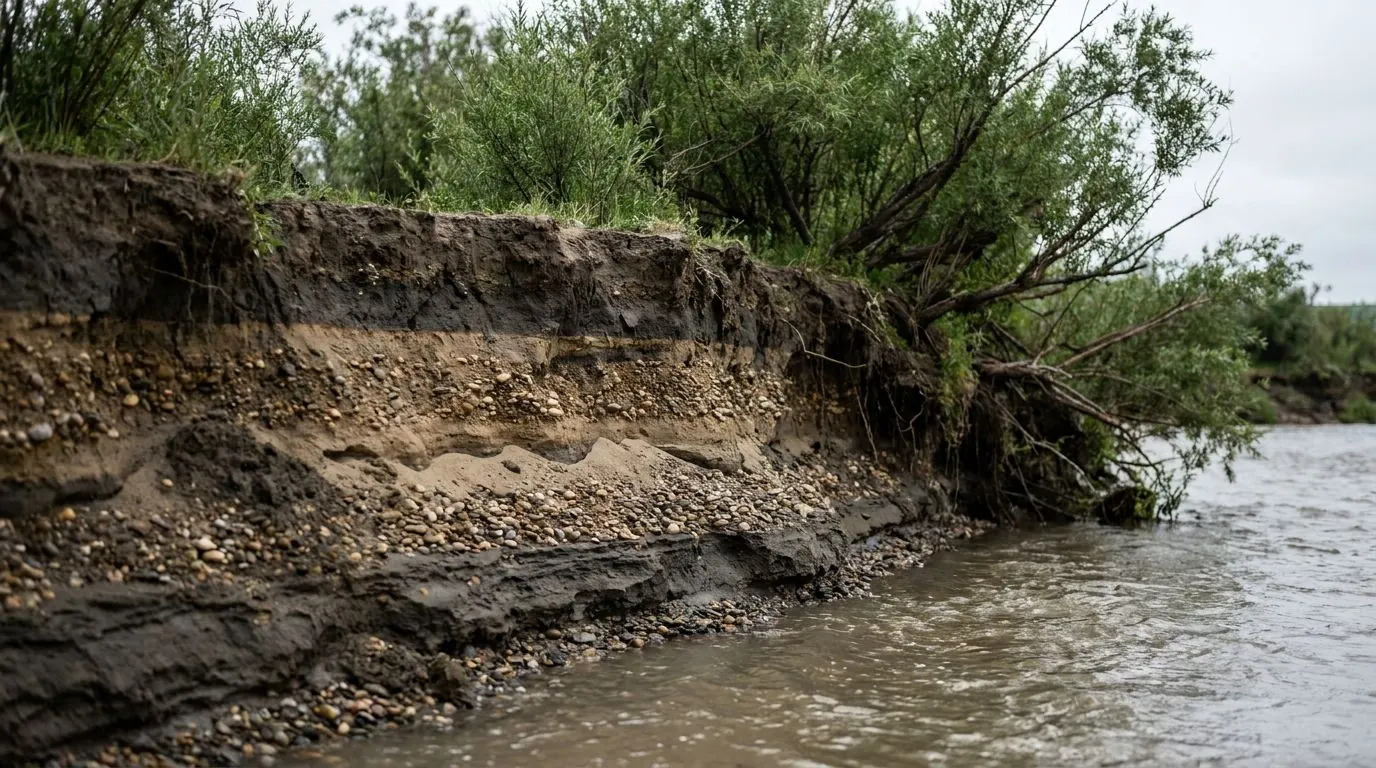
High River grew up on the banks of the Highwood River, and underneath it lies the kind of layered deposit a foothills river builds over time: alternating beds of silt, sand and gravel whose order shifts within a short walk. The Little Bow begins just east of the town. Depth to competent bearing on one street tells you very little about the next.
The flood of June 2013 reshaped that ground. Floodwater ran across roads and back yards, leaving silt behind on some lots and stripping soil from others, and the recovery that followed trucked in huge volumes of fill, rebuilt basements and lifted grades along entire blocks. The result is unique to this town. On a lot the flood reached, the top metre or two could be engineered fill placed during recovery, fill nobody controlled, or undisturbed alluvium — and you cannot tell which by looking.
Nowhere in our service radius makes a stronger case for verifying every screw pile by torque. Turning a pile to a preset depth through post-flood fill demonstrates nothing at all. Turning it until the measured torque matches the engineered load leaves a documented result — and on a rebuilt lot, neighbouring piles stopping at different depths is exactly what you should expect, not a warning sign.
The projects we see locally
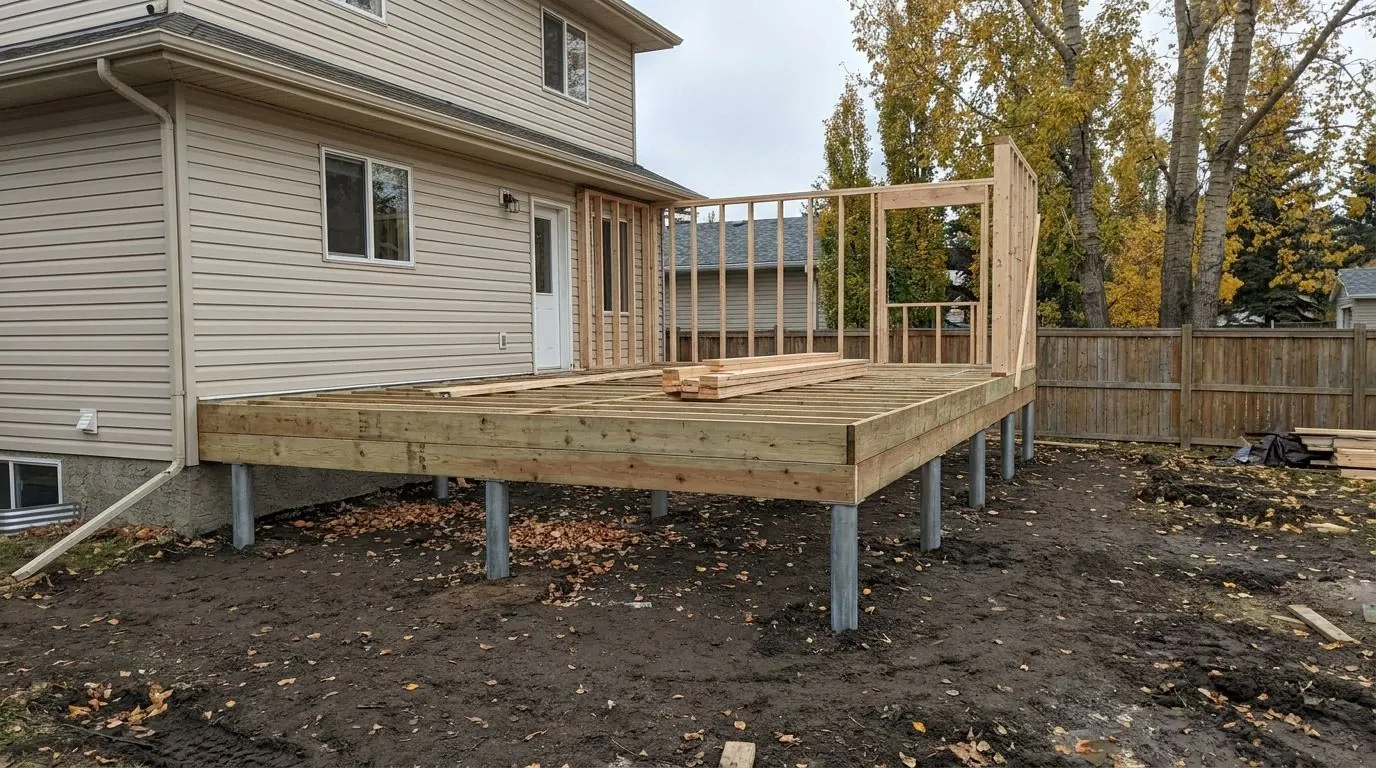
So many High River homes went through the recovery that the town sees an unusual share of one type of project: replacement decks and additions on repaired houses, garages rebuilt after being written off, and structures intentionally raised above grade. That last group suits helical piles especially well, since each pile is set to its own height instead of forming and pouring concrete to a line. We also get regular calls to repair settlement where a footing sitting in alluvium has moved unevenly.
Beyond the town boundary, acreages in Foothills County follow the rural pattern — post-frame shops, equipment storage, animal shelters and riding arenas — frequently on yard sites a long drive from the nearest concrete plant.
No screw pile here goes in to a preset depth. It keeps turning until the torque reading shows it has reached the capacity the engineer asked for, which in soil this variable can leave two piles a few metres apart ending at different depths — with neither one wrong. Read more on screw pile depth in Alberta .
Our High River coverage
The map outlines where we install, not a location to drop in on. With Chinook Screw Piles, the rig, the crew and the screw piles all travel to your property. High River and Foothills County sits inside our normal working radius, so quotes here carry no travel fee.
Town of High River (Foothills County outside town limits) handles permits for projects within the area on this map.
What We Do in High River
Jobs range from a few deck piles up to commercial foundations, with grade beams and underpinning in between. Open any service to read how it applies in High River.
Deck Foundations
Nothing to dig, nothing to cure — start framing that day.
Garage Foundations & Grade Beams
Screw piles and grade beams engineered around Calgary clay.
Home Additions & Sunrooms
Set close to the house while the old foundation stays untouched.
RTM, Modular & Mobile Home Foundations
Engineered screw pile foundations under RTM and modular homes.
Foundation Underpinning
Halt the settlement and carry the house on engineered screw piles.
Foundation Lifting & Levelling
Raise a sunken structure toward the elevation it started at.
Basement Wall Anchors & Tiebacks
Hold a bowing basement wall where it is — and often draw it back.
Slab Jacking & Concrete Lifting
Bring sunken concrete back to level and keep the slab you have.
Commercial Piling
Solar arrays, EV charger bases, sign footings and grade beams.
Industrial & Oilfield Piling
Pipe racks, wellheads, compressor stations and remote sites.
Engineering & Pile Load Testing
Stamped drawings, load tests and torque checked against capacity.
Also Close to High River
Our crews regularly work in these neighbouring communities as well.
Ground and projects around High River
High River Screw Pile FAQ
How deep does a screw pile foundation go in Alberta?
Is a screw pile foundation less expensive than concrete?
What are the drawbacks of screw piles?
Do screw piles go in during the winter?
Is there an extra charge to travel to High River?
Planning a screw pile foundation in High River?
Give us a call or send your project details, and we will get back to you with a price. Chinook Screw Piles is based in Calgary (WCB Alberta covered, Fully liability insured) and works across High River and Foothills County and the communities around it.