Sonotubes in Calgary: The Real Cost of a Poured Deck Footing
You can pick up a Sonotube for about what you’d spend on a sandwich, and that low price is a genuine advantage. Next to anything else that might end up carrying a deck, a cardboard form barely registers as a material expense.
The catch is that the tube was never where the money goes. It is the smallest entry on a longer list, and the items people overlook are the ones that sting.
What a poured footing actually involves
Every footing under a Calgary deck needs a hole that gets beneath the frost line, and in an ordinary winter frost here reaches well over a metre down. For each one, that means:
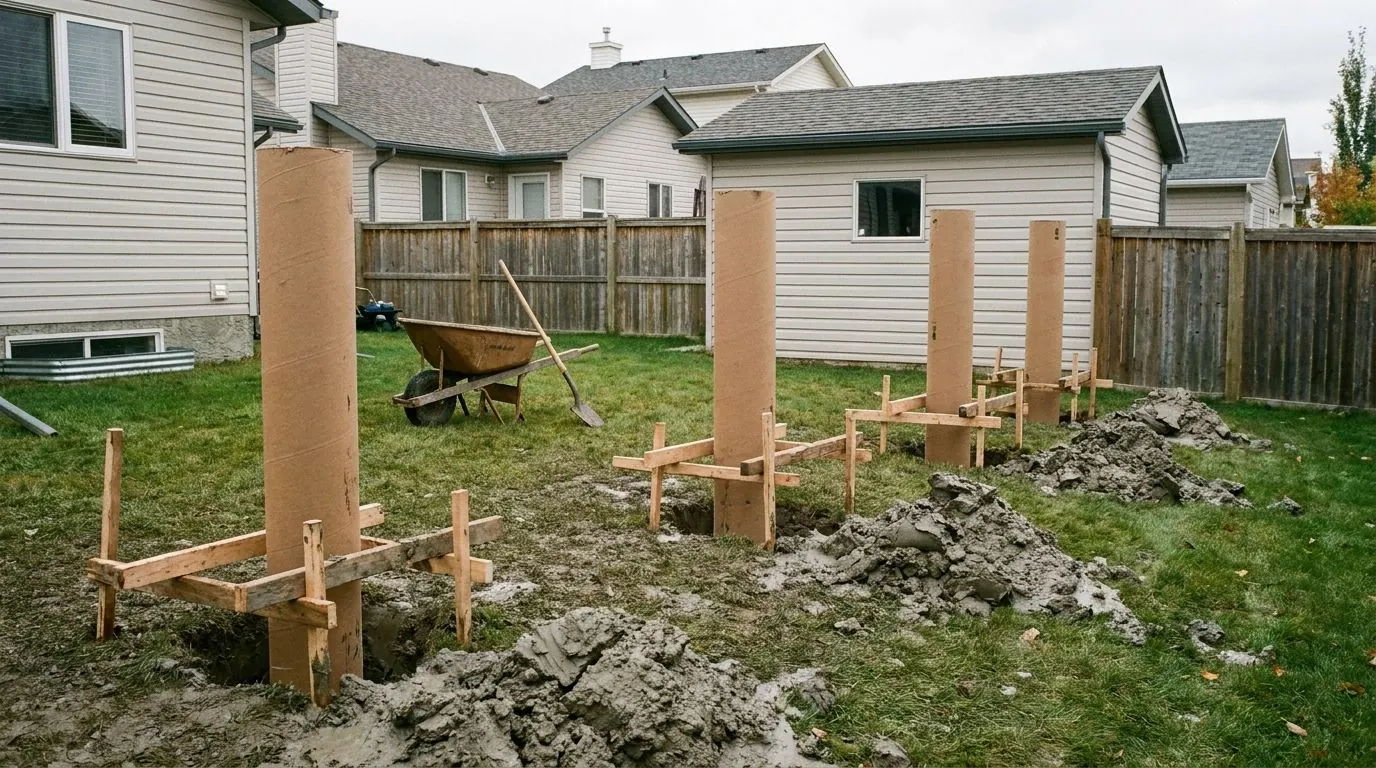
- Excavating by hand or with a rental auger. Augers struggle in clay, and a small one will stall outright on cobbles.
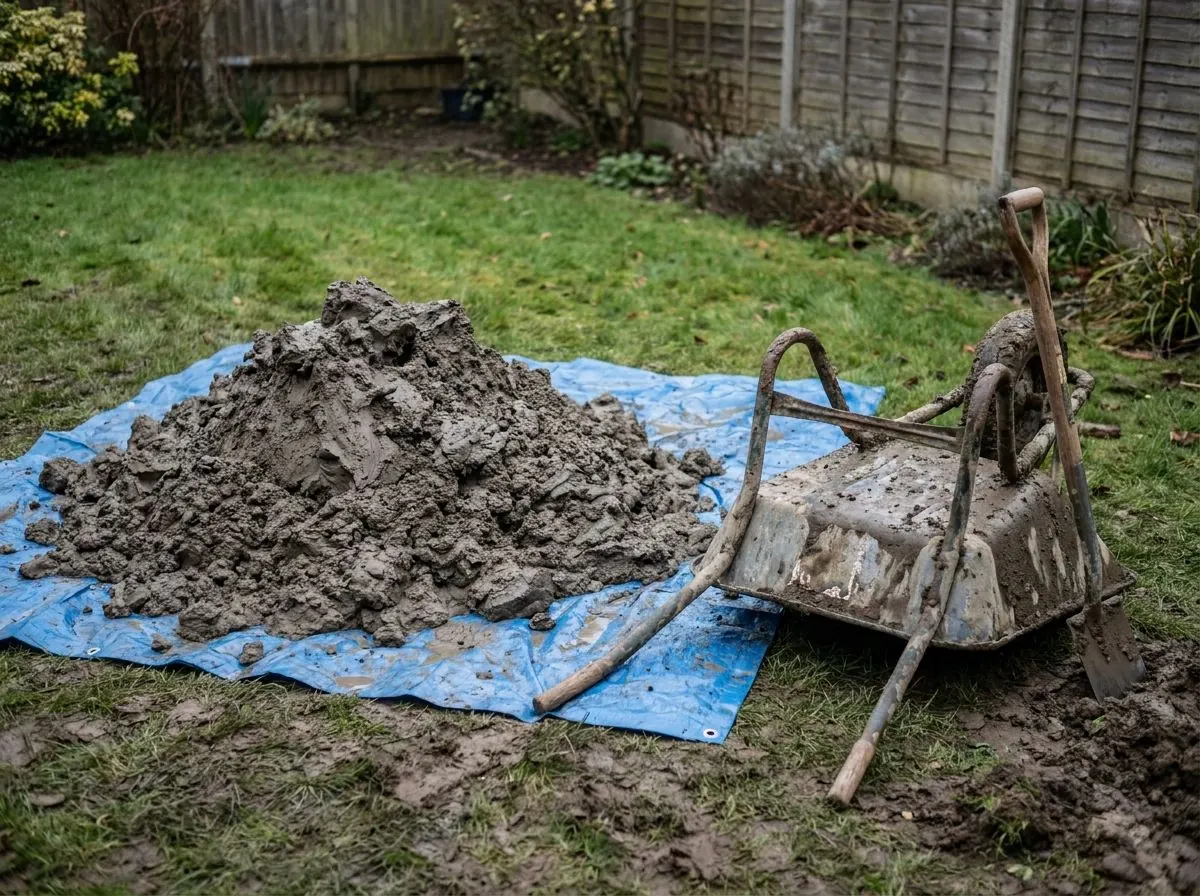
- Hauling the dirt out. Twelve holes that deep produce a surprising pile of clay, and it can’t just stay on the grass.
- Standing the tube plumb, bracing it and backfilling so it neither floats nor wanders.
- Filling it, with bagged mix for a handful of footings or ready-mix for more, and a wheelbarrow squeezed through a gate never built for one.
- Waiting for the concrete to cure before anything bears on it.
- Placing saddles or anchors in the wet concrete, correctly positioned and at the correct height, or drilling in epoxy anchors afterwards.
Nothing on that list is hard. Every item eats hours, though, and almost none of them show up when you’re pricing a tube at the store.
Where poured footings go wrong here
We run into three problems often enough that they deserve names.
Not actually below frost. People dig until the digging gets tough, not until they reach the depth required, and clay mixed with cobbles makes stopping early very tempting. A footing bearing above frost depth will heave, and it won’t heave evenly from one side of the deck to the other.
Blowouts and bells. Brace a tube only at its top and it may bulge or move as the concrete goes in. Wet clay walls can also cave, so you pour far more concrete than expected into a cavity you have no way of seeing.
Concrete alone is not capacity. A poured pier simply passes load down to whatever lies beneath it. If that material is soft or disturbed, you have a very sturdy block resting on something that isn’t sturdy at all, and the pour itself gives no clue which case you’re dealing with. This is what catches people off guard: flawless concrete work can still produce a footing that sinks.
Where poured footings genuinely win
We’re not here to argue that concrete should never be poured.
Three footings for a modest landing, a shovel already in the shed and a place to dump the soil? Pouring is inexpensive and perfectly sensible. Concrete is also the right material when load has to spread across an area instead of a point, as with a slab-on-grade, a monolithic pad or a grade beam carrying load along its length.
Some properties also shut out machinery entirely, leaving hand-digging as the only practical route. If yours is one of them, we’ll say so.
How the comparison actually breaks down
Compare the finished foundation, not a tube with a screw pile:
| Poured in Sonotube | Screw pile | |
|---|---|---|
| Below frost | Only if the hole reaches deep enough | Driven until torque confirms it |
| Excavation | One hole for every footing | None |
| Spoil | Yes, and it must be hauled off | None |
| Cure before loading | Days | None — framing can start the same day |
| Weather window | Frozen ground makes pouring difficult | Year-round |
| Capacity | Assumed on site from the design | Measured on each pile |
| Documentation | Nothing unless requested | A torque log for every pile |
For most homeowners, cure time is the row that counts, since it determines whether the deck takes one weekend or three. An engineer will look straight at the bottom row: a helical screw pile leaves behind a recorded capacity figure instead of an assumption.
What it costs
You won’t find a per-footing price in this article. We only publish figures we’ve checked against actual quotes, and an invented comparison would do you more harm than having no numbers at all.
What we can explain is where spending really lands, since that’s what most people misjudge. With a poured footing, the tube and the mix are the minor expenses; the big ones are labour, equipment rental, getting rid of spoil and the days lost between excavation and framing. With a screw pile foundation, the steel and the installation make up nearly the entire bill, with no return trip.
Cost out both options fully, including spoil removal and the calendar time each one takes, and the right choice usually becomes obvious without any sales pitch.
If you have already dug
That doesn’t lock you in. Screw piles don’t use the holes you’ve already opened, and half-finished excavations are one of the more common reasons people get in touch. Have that conversation before the concrete order goes in, not after.
Worth reading next: how deep piles actually go here, screw piles versus concrete on cost, and how many a deck needs.
Send us the deck dimensions and we’ll tell you what your deck needs, even if the answer turns out to be pouring.
Thinking about screw piles for your project?
Questions after reading this, or ready for a price? Get in touch — we install screw pile foundations in Calgary and the towns around it.