Deck Blocks vs Screw Piles in Calgary: When Blocks Hold and When They Heave
Nothing lifts a deck off the dirt more cheaply than deck blocks, and for certain decks they’re exactly what you should use. The trouble is they get marketed as suitable for everything — and Calgary soil disagrees.
The entire debate fits in one line: a deck block rests on the surface, and the surface doesn’t stay still.
Can I use deck blocks instead of footings?
In some cases. And what decides it is rarely the price.
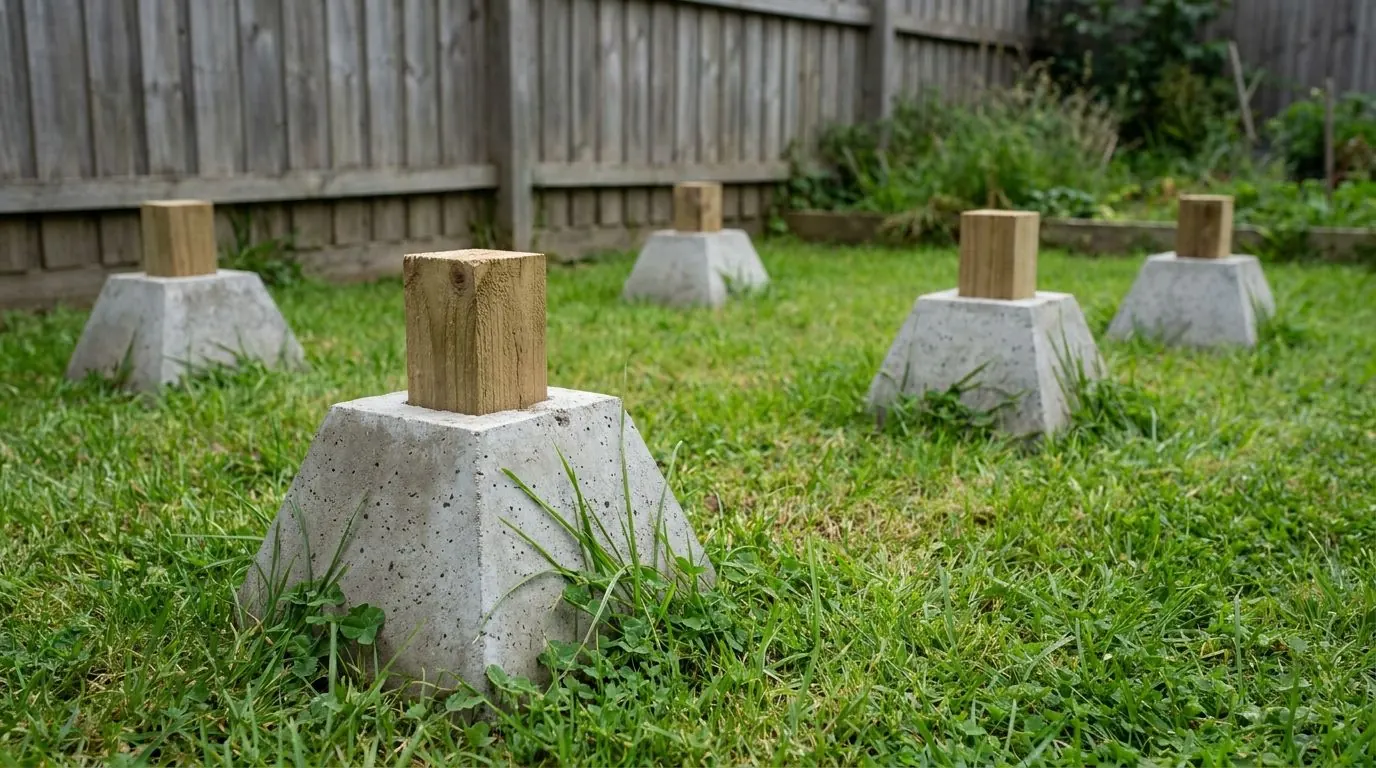
The precast block — that pyramid-shaped “elephant foot” sold by the pallet — is simply a pad that spreads weight over a small patch of soil. It stops short of the frost line. It isn’t anchored to anything. Its only support is the ground right below it, and it assumes that ground never shifts.
That works for a structure that can tolerate some movement, stands apart from the house, and sits so low that a little seasonal up-and-down is a cosmetic nuisance rather than a structural concern.
Everything outside that description is a poor fit — and in Calgary, that covers more decks than people assume.
Can you use deck blocks in Canada?
You can, but frost changes the answer here compared with somewhere like Ohio.
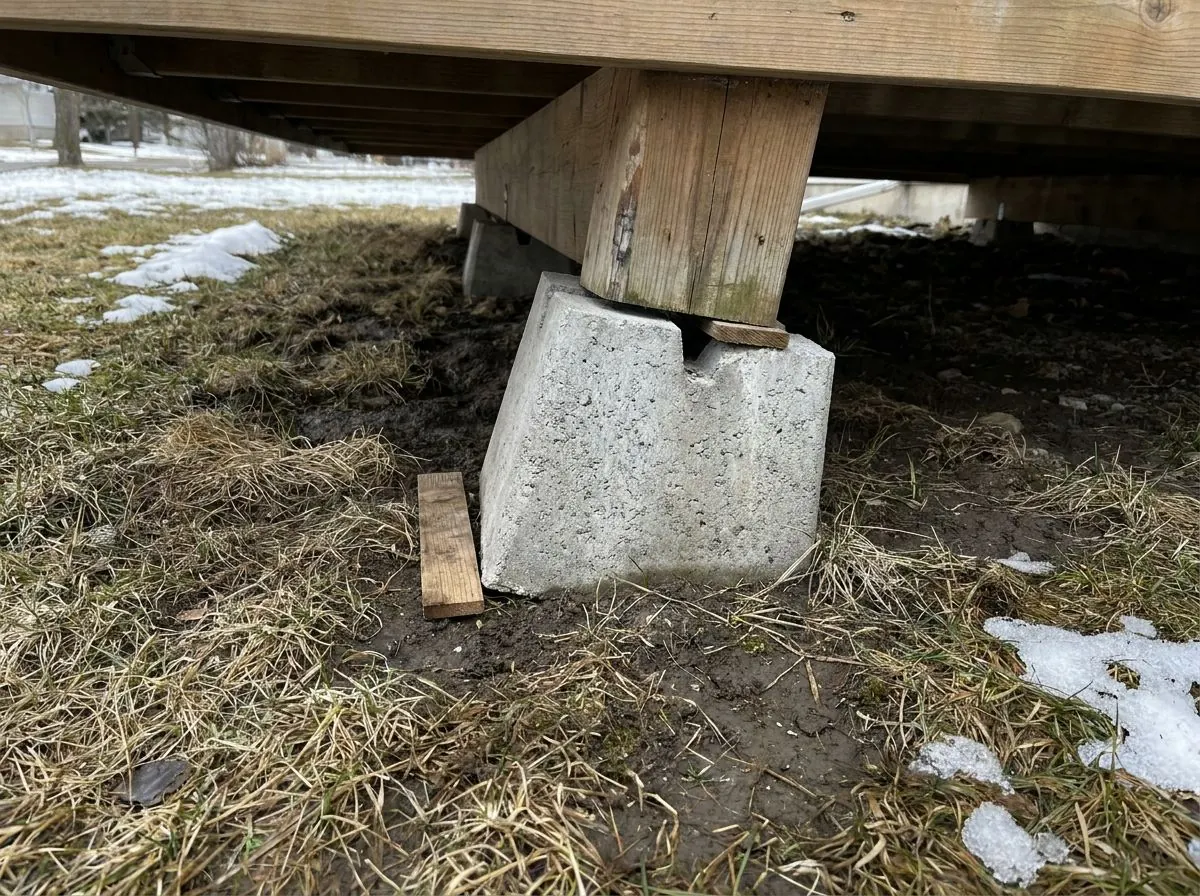
Around Calgary, frost regularly goes deeper than a metre. Load-bearing foundations are meant to bear beneath that, in soil that stays unfrozen and so doesn’t heave. A deck block sits on grade — squarely in the zone that freezes, thaws and shifts each year, and here it can happen several times a winter as chinooks thaw the soil before it freezes again.
Layer on Calgary clay, which expands when wet and contracts when dry, and two separate forces are working on the same block. That’s how a block-supported deck that was perfectly level in September ends up noticeably off by April — and then partly settles back over the summer, leaving owners wondering if they imagined it.
Blocks aren’t against the rules because of this. They’re just a bad match for anything that must stay where you built it.
Permits come into it too, and there’s a definite answer we won’t pretend to know for you: the deck height that triggers a permit, and the foundation it then needs, is decided by your authority having jurisdiction — the City of Calgary, Airdrie, Rocky View County and the others each handle this on their own. Check first. A block foundation that fails inspection is a costly way to learn.
When not to use deck blocks
Four cases where blocks are a poor choice no matter the budget:
Any deck fastened to the house. With a ledger bolted to the rim joist, one side of the deck rides on a foundation below frost and the other on blocks above it. The two will move independently, and the connection where they meet — on your house — takes the strain.
Any deck needing a permit. When an inspector is involved, the foundation needs to be one a code official accepts as a foundation.
Any deck standing high. Height turns minor shifts into visible lean, and worsens the outcome if a post slides sideways instead of simply rising.
Any deck with a heavy point load. A hot tub is the usual example. Water plus bathers packs a lot of weight into a small area — the textbook situation for engineered capacity instead of a block sitting on soil.
Blocks are sensible for a small, low, freestanding platform, separate from the house, below the permit threshold, where you’re fine re-levelling now and then. A grade-level sitting deck at the back of the lot is a legitimate job for deck blocks. Being upfront about that misleads no one.
“Deck footings without digging” — the real need behind the search
That search phrase reveals what most people are really after. It isn’t blocks as such. It’s a deck foundation that skips digging a dozen holes, mixing or ordering concrete, waiting days for it to set, and disposing of the dirt.
What they’re describing is a screw pile. A steel shaft with a helix at the lower end is rotated into the ground until torque shows it has reached soil able to carry the load — below frost, in a single pass, with no excavation or spoil. Framing can begin that same day.
So the real comparison isn’t just blocks against piles. It looks like this:
| Deck block | Poured footing | Screw pile | |
|---|---|---|---|
| Below frost | No | Yes | Yes |
| Excavation | None | One hole per footing | None |
| Spoil to haul | None | Yes | None |
| Cure time | None | Days | None |
| Capacity known | No | By design | Verified by torque |
| Inspectable | Barely | Yes | Yes, backed by a torque log |
Screw piles keep the two features people like about blocks — no digging and no waiting — and add the one blocks can’t provide: bearing beneath the soil that moves.
Our advice if we were standing in your yard
For a low freestanding platform, where re-levelling every so often doesn’t bother you, go with blocks and put the savings into nicer decking boards.
For a deck tied to the house, requiring a permit, sitting higher than a couple of steps off the ground, or supporting a hot tub, blocks only look like a saving — not because they’re inexpensive, but because the way they fail is a deck gradually drifting out of level with no tidy fix short of rebuilding the foundation.
Read next: how many screw piles a typical deck needs, what frost depth means for Calgary decks, and the way Calgary clay moves.
For a direct answer on your own deck, send us its size and height and we’ll say what it needs — even if that turns out to be blocks and no contractor at all.
Thinking about screw piles for your project?
Questions after reading this, or ready for a price? Get in touch — we install screw pile foundations in Calgary and the towns around it.