Concrete Footings, Piles and Piers: A Plain Guide to Foundation Terms
People swap five foundation terms around as though they meant the same thing, and the mix-up costs money. A homeowner requests a “footings” quote but actually needs piles, or asks a Calgary contractor for “piers” after watching an American video and gets a puzzled look.
Below, each term in plain language.
Footing
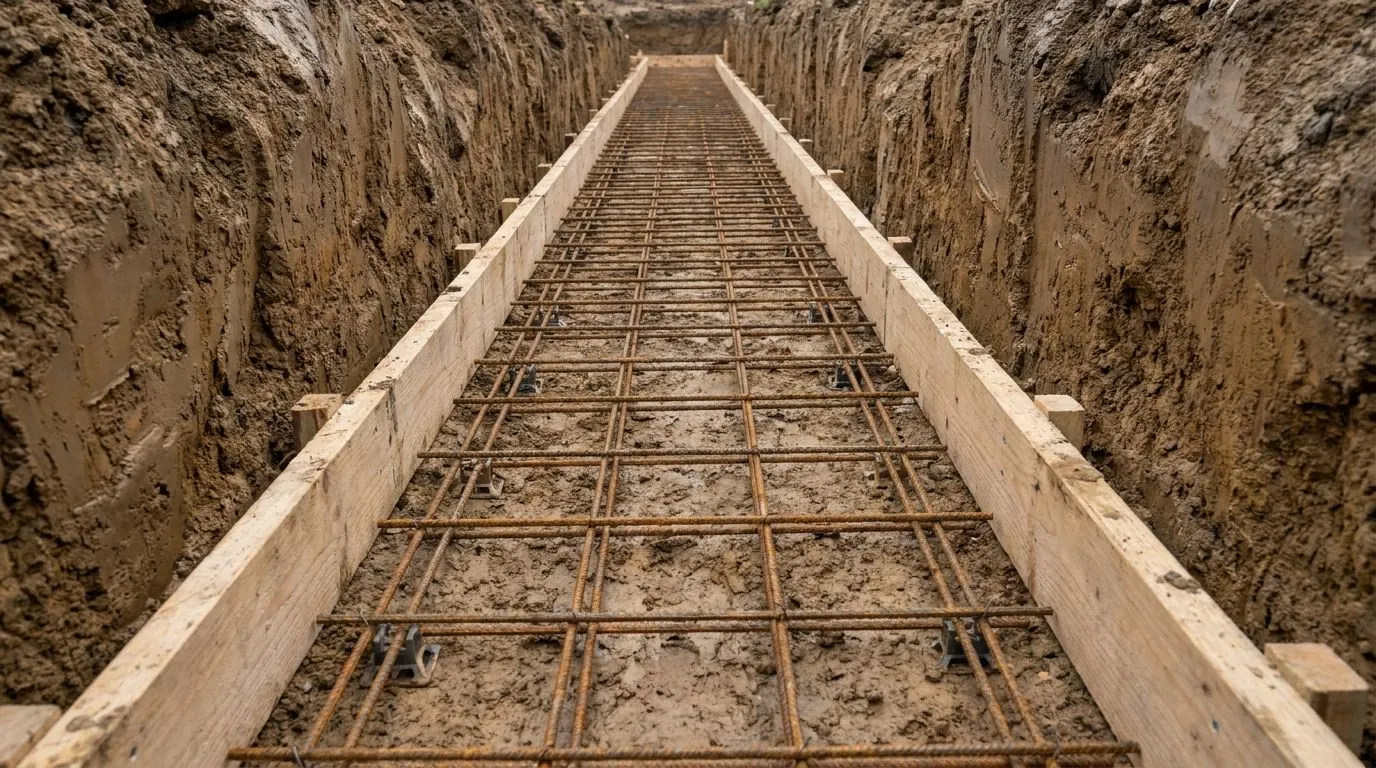
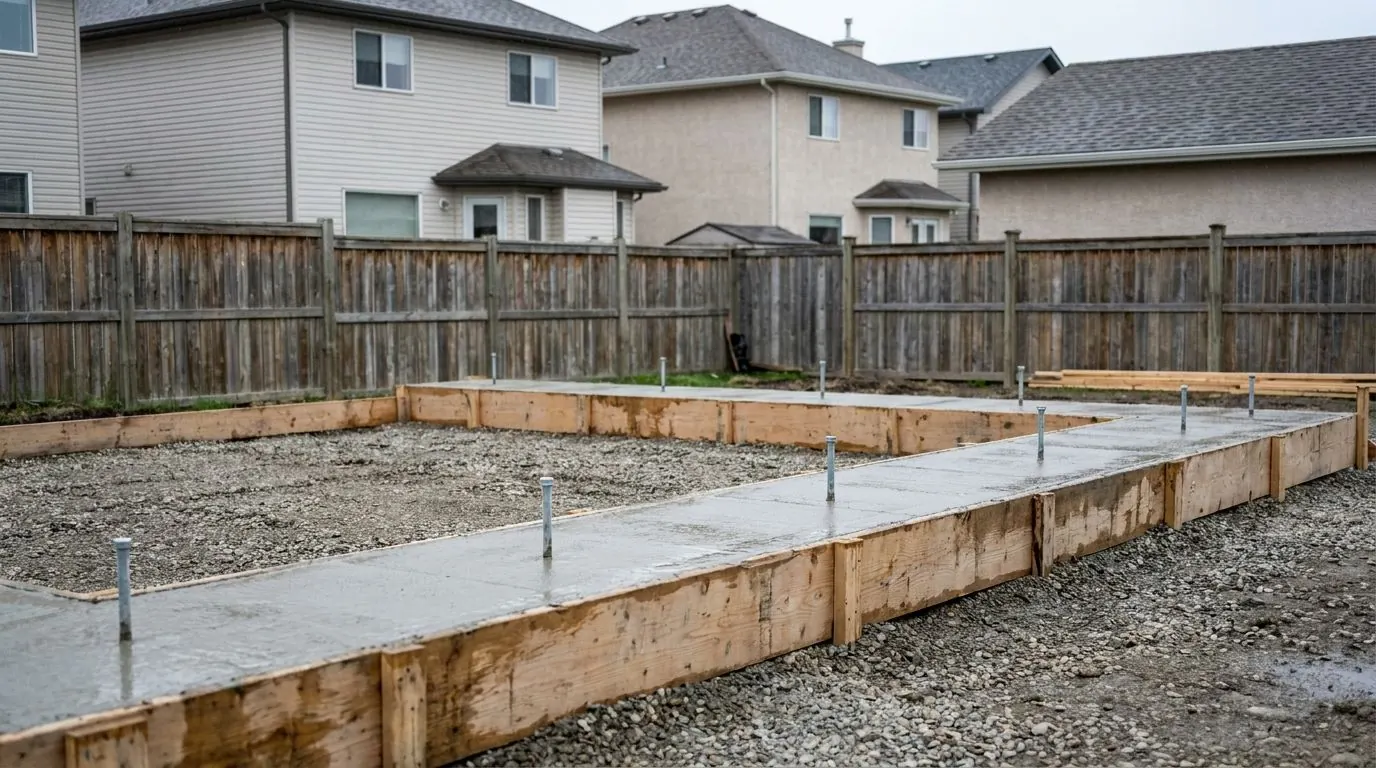
A footing is an enlarged base that distributes weight across enough ground for that ground to support it. It’s where the building meets the soil.
What sets a footing apart is being wide and shallow: it does its job through surface area. The continuous strip below a foundation wall, a square pad beneath a post, a slab with a thickened perimeter — every one is a footing. Each depends on the soil right underneath being sound and not moving.
On the prairies, that dependence is the weak point. Footings must sit below frost, and around Calgary frost typically reaches deeper than a metre in an ordinary winter. A “shallow” foundation in this city is therefore anything but, which explains why digging a deck footing by hand is so miserable.
Pile
A pile is long and narrow, and relies on depth instead of area. It supports load by resting on firm material far below grade, through skin friction along the shaft, or a mix of the two.
Piles come in when the upper soil can’t be trusted — it’s too soft, it heaves and settles with the seasons, or the load is too concentrated to spread out.
Most foundation jargon comes from how a pile is installed:
- Driven piles — pounded in with a hammer. Steel or precast concrete, loud, and typical of large civil projects.
- Bored / cast-in-place piles — drill a hole, fill it with concrete. Sometimes called drilled shafts; in Alberta usually caissons.
- Auger cast piles — concrete is pumped down a hollow-stem auger while it’s pulled back out.
- Helical (screw) piles — a steel shaft carrying one or more helix plates, rotated into the soil. Screw piles are our core work.
Concrete pile versus concrete footing
These two are mixed up all the time, yet they’re not the same thing.
A concrete footing is broad and near the surface, spreading load outward. A concrete pile is slim and deep, carrying load downward. A Sonotube poured for a deck post falls in the middle — it gets called a footing, a pier or a pile depending on who’s talking, but it’s essentially a stubby cast-in-place pile performing a footing’s role.
Where it counts is when the upper soil starts moving. A footing is at its mercy; a pile is built to bypass it.
Pier
Pier is the most confusing of the five, since what it means depends on where the writer is from.
Much of the residential foundation-repair marketing in North America comes from the US, where “pier” loosely means any upright support — hence all the “helical piers” and “push piers.” Canadian and engineering usage tends to reserve pier for a large vertical support such as a bridge pier, while the smaller residential elements are piles.
Knowing this mainly helps when reading American material. A “helical pier” in a US video is what we’d call a helical pile, and in Calgary asking for piles will get you understood faster.
Grade beam
A grade beam is reinforced concrete that spans from pile to pile (or pier to pier), picking up wall or floor loads and delivering them to those supports.
For a garage or small outbuilding, this pairing is often exactly the right design: screw piles carry the load down to good soil, and a grade beam bridges between them to support the walls. That’s a deliberate hybrid, not a half-measure.
Which one does your project need?
As a rough guide only — the engineer makes the real call:
| Situation | Typical choice |
|---|---|
| Slab, patio or driveway on stable soil | Footing or slab-on-grade |
| Low, freestanding deck | Footing, pile — or blocks for a small one |
| Deck ledgered to the house | Pile bearing below frost |
| Garage or workshop | Piles plus a grade beam |
| Building on a slope, fill or soft clay | Piles |
| Settled existing foundation | Piles underpinning the existing footing |
| Loading beside a structure you can’t dig next to | Piles |
The rule of thumb: footings where the upper soil is sound and stable; piles where it isn’t, or where finding out the hard way isn’t affordable.
Why we turn in helical screw piles instead of pouring
Concrete isn’t the enemy. Plenty of foundation jobs are best done in concrete, and when a project calls for a slab or a wide bearing surface, we’ll tell you.
Helical screw piles come out ahead under particular conditions, and it’s worth being exact about them:
- Nothing to dig or haul. No excavation, no spoil to truck off, no yard to restore. On a landscaped property, that alone often settles it.
- No waiting for a cure. Framing can start the day the piles go in.
- Capacity that’s been checked. Torque at installation correlates with load capacity, so each pile’s rating is measured and logged on site instead of being an untested design assumption. That’s the key distinction, and why engineers sign off on them.
- Installs in any season. Screw piles go through frozen ground; fresh concrete and frozen soil don’t mix well.
- Fits tight spaces. Equipment small enough to pass through a gate.
Concrete remains the better pick for wide bearing surfaces, slabs, designs where a grade beam carries the structure, and sites where the near-surface soil really is sound and always has been.
The honest summary
When a quote for a house-attached deck just says “footings,” ask two things: how deep, and what evidence says the soil at that depth will carry the load. Those questions clear up most of what this article covers — and they apply equally whether you end up with concrete or steel.
Further reading: typical screw pile depths in Alberta, what a torque reading tells you, and how screw piles compare on cost with concrete.
Thinking about screw piles for your project?
Questions after reading this, or ready for a price? Get in touch — we install screw pile foundations in Calgary and the towns around it.