What Is Torque Monitoring, and How Much Weight Can a Screw Pile Support?
Torque monitoring is what separates a helical screw pile from a post dropped into a hole. Before you pay for either, it helps to know how it works.
The basic idea
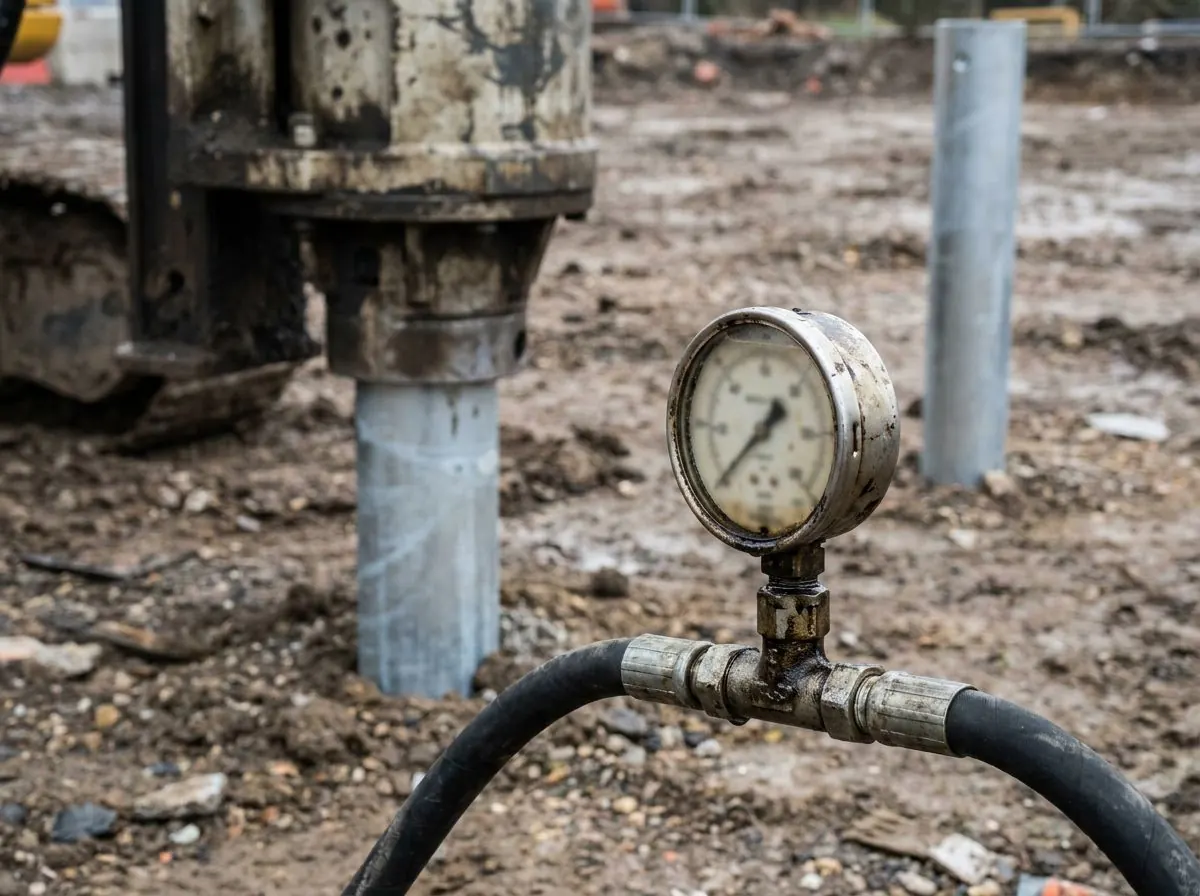
Turning a helical pile down into soil meets resistance, and that resistance is recorded as installation torque.
There is a correlation between torque and the bearing capacity of the soil. In practice it has proven reliable enough to be the standard field method for confirming helical pile capacity: the pile keeps advancing until torque hits the figure tied to the capacity required, and that reading is the proof.
Engineers normally express this as a capacity-to-torque ratio, which varies with the shaft. Slimmer shafts carry a higher ratio than wider ones, and the design states which ratio governs.
Why this matters more than depth
Write “piles to 3 metres” into a spec and all you’ve described is a length of steel.
Write “piles installed to a torque corresponding to X kN capacity” and you’ve described an actual foundation.
Depth is the result, not the goal. Piles on one lot can stop metres apart from each other and still both be right, because one hit competent bearing earlier. Reaching the required torque is the thing that makes each of them correct.
Here lies the real edge over a poured pile. Concrete gets inspected, poured and buried, so you’re relying on the process having gone well. Every helical pile, by contrast, is measured right as it goes in.
What makes the correlation defensible: CCMC
A contractor can’t simply declare a torque-to-capacity relationship. For certified pile systems, it is published.
The Canadian Construction Materials Centre, which sits within the National Research Council, issues evaluation reports on construction products, helical screw piles among them, assessed against the National Building Code. Each system’s report lists allowable compressive and tensile capacities based on final installed torque: load tables certified against torque, not a contractor’s rule of thumb.
That’s how a torque reading becomes a figure fit for a permit submission. The installer logs final torque at every pile location, the report states the capacity that torque represents for that exact product, and together they form the evidence.
A few limits to keep in mind:
- It is product-specific. Tables apply to one particular pile system. A torque figure taken from one manufacturer’s report can’t be applied to another manufacturer’s steel.
- The tables have limits. When the design load falls outside the range an evaluation covers, table lookup no longer applies and site-specific load testing overseen by a professional engineer takes over.
- The evaluations are public and they expire. Current evaluations can be looked up by anyone in the CCMC Registry of Product Assessments. When a supplier says their pile is CCMC-listed, you can confirm it in roughly a minute, and you should.
So how much weight can a screw pile support?
No one number answers this. Treat anyone who offers one without asking questions first with some suspicion.
What capacity depends on:
- Shaft size and wall thickness
- Helix diameter, and the number of helices
- Soil — one pile can carry wildly different loads in dense till versus soft clay
- Direction of load — compression, tension (uplift) and lateral capacity each have their own value
- Design factors used to step down from ultimate to allowable capacity
Figures floating around online run from a few thousand pounds for light-duty screws driven by hand up to hundreds of kips for heavy industrial shafts. Each figure is accurate for a very different product.
A better question than “how much will a screw pile hold?” is “what capacity does my structure need, and what will this pile deliver in this soil?”
Uplift matters more than people expect
Across Alberta, uplift rather than compression frequently controls the design.
When expansive clay swells in a wet season, it pulls up on a pile, putting it in tension. Wind does the same to light buildings; a post-frame shop or farm building may carry little vertical load yet need substantial resistance to uplift.
Helices handle uplift well, and that’s a big reason screw piles suit this part of the country. It still has to be designed rather than taken for granted, so ask whether a quoted capacity refers to compression, tension or both.
What you should receive
On any engineered installation, expect:
- A torque log listing installation torque for each pile
- The capacity that corresponds to, along with the ratio applied
- As-built locations and depths
- Drawings stamped by an APEGA-licensed P.Eng. wherever the permit calls for them
An installer with no torque log hasn’t verified a thing. Raise that question before signing the contract, not once the work is done.
Load testing
Some projects need more than a torque correlation: bigger industrial jobs, unusual ground or a client spec that demands it. In those cases piles can be load tested physically, in compression, tension or laterally, by applying load in stages and measuring how far the pile moves.
Testing adds cost and time, and on the right job it’s fully warranted. We’d rather walk you through when it makes sense than push it as a default add-on.
The short version
A helical pile proves its capacity through torque, and its depth is simply however far it had to go to get there. If someone sells you a depth with no capacity attached, you’re paying for steel, not a foundation.
Read more for engineers and inspectors, or about our engineering and pile load testing.
Thinking about screw piles for your project?
Questions after reading this, or ready for a price? Get in touch — we install screw pile foundations in Calgary and the towns around it.