What Are Screw Piles? A Plain Guide
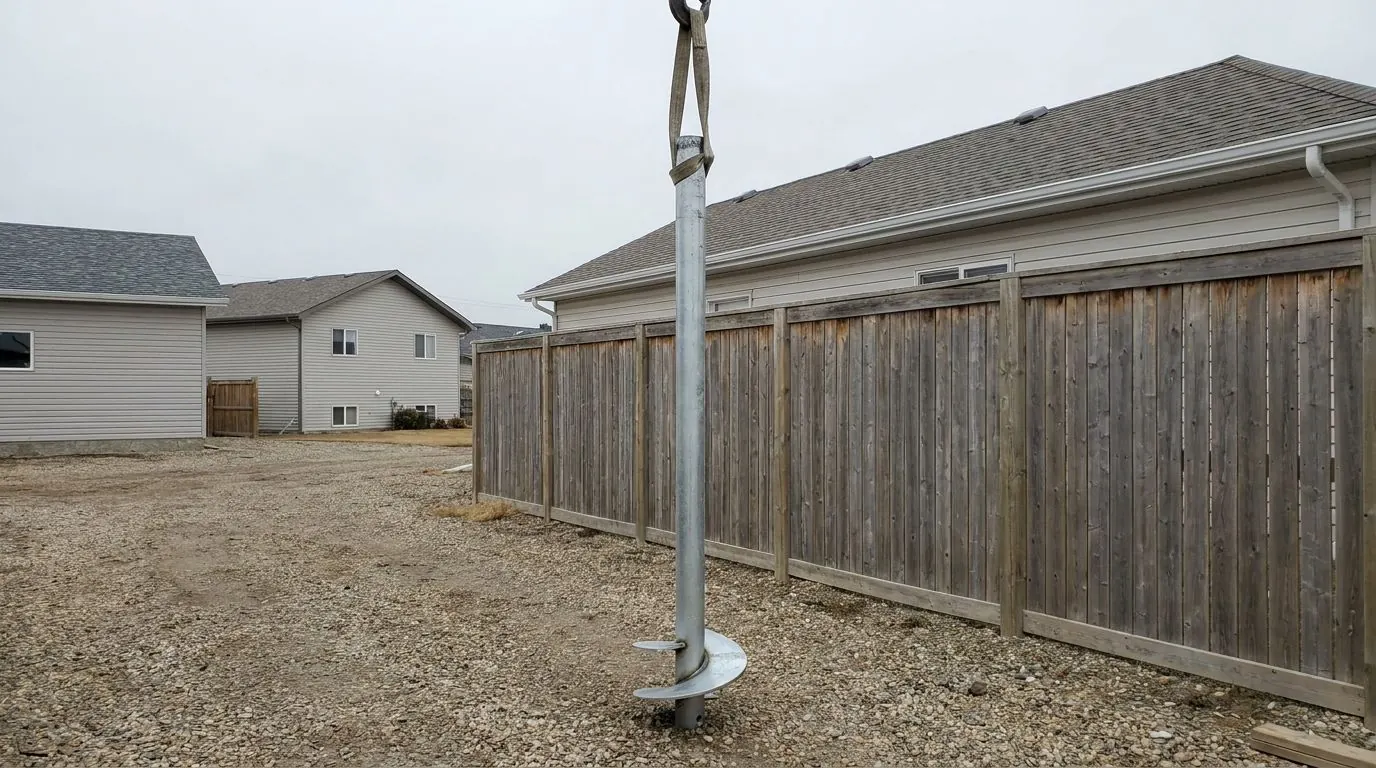
Picture an oversized wood screw made of steel. A screw pile is a galvanized shaft carrying one or more welded helical plates near its tip, turned into the soil by a machine until it bottoms out in ground strong enough to hold the structure. On top sits a bracket that connects to whatever is being built.
That’s the core concept. The rest is refinement.
Screw pile, helical pile, helical pier — what’s the difference?
In practical terms, none. It’s a single product that goes by three labels.
- Screw pile is the everyday Canadian name and easily the most common one locally
- Helical pile leans technical and turns up often in engineering documents
- Helical pier is favoured south of the border, especially in foundation repair
So if your quote says one and your drawings say another, both refer to the same piece of steel.
How they carry load
Two effects combine:
End bearing. Much like a footing, the helix pushes down on the soil below it, only at far greater depth and on firmer ground.
Shaft friction. Along the shaft, the surrounding soil grips the steel and contributes extra capacity.
On top of that, the helix resists uplift, the upward pull created by expansive clay and wind. Across Alberta, that force frequently matters as much as downward load does.
How deep do they go?
There isn’t a set figure. A helical screw pile goes as deep as torque tells it to.
Installation torque is tracked while the pile advances, and it correlates with bearing capacity, so driving continues until torque matches the engineered load. Around Calgary that always puts the helix under the frost line, commonly cited at roughly 1.2 to 1.8 metres, and your engineer confirms the depth for your site.
On a single site, piles may stop at different depths and still all be correct. The full explanation is in how deep screw piles go in Alberta.
How long do they last?
In typical soils, galvanized piles are engineered for a service life counted in decades; manufacturers commonly cite 75 to 100 years for their systems.
Be cautious with any one number, though. Lifespan comes out of the design, driven by steel thickness, coating and soil corrosivity, rather than being a built-in trait of the product. Corrosive ground calls for its own specific design.
What they get used for
Residential — decks, sheds, hot tubs, garages, sunrooms, home additions, garden suites, RTM and modular homes, and fence and gate posts.
Foundation repair — crawlspace support, underpinning footings that are settling, and lifting or re-levelling structures.
Commercial — boardwalks, grade beams, solar arrays, EV charging infrastructure, and bases for signs and light poles.
Industrial and oilfield — pipe racks, tanks, substations, wellhead supports, compressor stations and remote sites.
One principle covers everything from a backyard shed to a compressor station. The variables are shaft size, helix arrangement and the depth of engineering behind the design.
Why they suit this region
Three Alberta-specific reasons:
Frost. Here, everything depends on bearing under the frost line, and piles get there without anyone digging down to it.
Reactive clay. Moisture makes Calgary clay swell and shrink. With its helix anchored beneath that active layer, a pile sits out the cycle.
Winter. Concrete can’t go into frozen ground, but screw pile installation carries on, so foundation work continues through months when pouring isn’t an option.
What they are not good for
Sites with shallow bedrock, which leave the helix nowhere to go. Structures that need continuous bearing instead of point support. And very high pile counts on open, easy-access sites, where concrete tends to become the cheaper route.
The complete rundown is in the downsides of screw piles.
What you should get with them
- A torque log covering every pile
- The verified capacity each torque reading represents
- Stamped engineering if the permit calls for it
- An as-built recording final locations and depths
Lacking those, all you really have is steel underground and a promise.
Just starting out and unsure what your project calls for? Tell us what you are building — or begin with what screw piles cost in Calgary.
Thinking about screw piles for your project?
Questions after reading this, or ready for a price? Get in touch — we install screw pile foundations in Calgary and the towns around it.